In a bold and provocative statement on Tuesday, Elon Musk revealed his intention to discuss a controversial new proposal with President Trump—a proposal that has been dubbed the “DOGE refund.” The concept, which calls for issuing tax refund checks to American citizens funded by savings generated through the federal DOGE initiative, has ignited vigorous debate among political commentators and fiscal watchdogs alike.
A Vision for Fiscal Reform
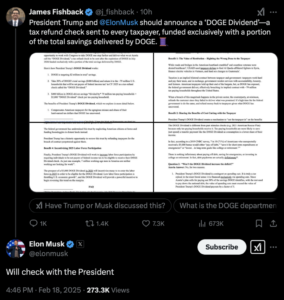
The idea was originally pitched by James Fishback, the CEO of Azoria, an investment firm that has been serving as an outside advisor to the DOGE program. In a widely circulated post on X (formerly Twitter) last Friday, Fishback outlined his vision: “American taxpayers deserve a ‘DOGE Dividend’—20% of the total savings generated by DOGE should be returned to hard-working Americans as a tax refund check. It’s their money in the first place!” He further explained that, given DOGE’s estimated savings of $2 trillion and a base of 78 million tax-paying households, each household could potentially receive a refund of approximately $5,000, with the remainder of the savings allocated toward reducing the national debt.
Fishback’s proposal is designed to address what he describes as taxpayer-funded government waste. The DOGE initiative—a program established through an executive order on day one of President Trump’s term—was created to modernize federal technology and software systems, thereby enhancing governmental efficiency and productivity. According to the running tally on doge.gov, DOGE has saved American taxpayers roughly $55 billion to date. These savings have been achieved through a variety of measures, including fraud detection and deletion, contract and lease cancellations and renegotiations, asset sales, grant cancellations, workforce reductions, programmatic changes, and regulatory streamlining.
Musk’s Response and the Political Implications
Elon Musk responded to Fishback’s provocative post on Tuesday evening, shortly after his side-by-side interview with President Trump aired on Fox News. “Will check with the president,” Musk stated succinctly, indicating that he would discuss the proposal directly with President Trump. In a follow-up post, he emphasized that the decision ultimately rests with the President: “Obviously, the President is the Commander-in-Chief, so this is entirely up to him.”
The suggestion of a “DOGE refund” resonates with a growing sentiment among certain factions that a portion of government savings should be directly returned to taxpayers. Proponents argue that such measures could help rebuild public trust in government by demonstrating a tangible return on the sacrifices made by American citizens. Critics, however, caution that the logistics of implementing such a program could be complex and that diverting savings from budgetary goals to direct refunds may not address the underlying issues of bureaucratic inefficiency.
Examining Federal Savings and Bureaucratic Overreach
During a press conference on Tuesday, President Trump listed several federal spending projects that the DOGE initiative has recommended for cuts. These included projects as diverse as $25 million to promote biodiversity and conservation efforts in Colombia, $40 million aimed at improving the social and economic inclusion of sedentary migrants, and $42 million allocated for Johns Hopkins University to research social and behavioral change in Uganda. Trump’s remarks were a pointed critique of the federal bureaucracy’s allocation of funds, highlighting examples of spending that he argued were out of touch with the needs of American citizens.
“Look at these numbers,” Trump commented during the briefing. “What about social change in our own country?” His questions underscored a broader criticism that excessive federal spending on foreign and non-essential projects undermines domestic priorities.
Musk, in his conversation with President Trump, concurred with this perspective. “They wouldn’t be complaining so much if we weren’t doing something useful, I think,” Musk remarked, referring to the federal savings accumulated by the DOGE program. He went on to criticize what he perceives as the unchecked power of an unelected bureaucracy, noting, “There’s a vast federal bureaucracy that is implacably opposed to the president and the cabinet. If the bureaucracy is not reined in, the will of the people is not being implemented. And that means we don’t live in a democracy—we live in a bureaucracy.”
Restoring Democracy Through Fiscal Accountability
Musk’s comments highlight a central theme in the ongoing debate over government spending and fiscal accountability: the need to restore the voice of the people in federal decision-making. His assertion is that reining in bureaucratic excess is not merely a matter of saving money, but of reinvigorating the democratic process by ensuring that taxpayer dollars are used in ways that directly benefit American citizens.
The proposed “DOGE refund” could serve as both a symbolic and practical measure of this rebalancing. By returning a portion of the savings directly to taxpayers, the initiative could foster a greater sense of ownership and participation in government financial decisions. However, critics warn that such a program must be carefully designed to avoid unintended consequences and ensure that it does not undermine essential governmental functions or the broader fiscal strategy.
The Future of the DOGE Initiative
The DOGE initiative, named in line with President Trump’s broader agenda to modernize federal technology and cut government waste, remains a subject of intense scrutiny. As of now, DOGE’s success is measured by a combination of cost savings and efficiency improvements across multiple federal departments. With a current estimated savings of $55 billion and ambitious goals set for the future, the potential for further fiscal reforms is enormous.
While DOGE itself does not have the power to legislate or directly enforce budget cuts, its recommendations have already influenced significant changes in government spending. The debate over the “DOGE refund” underscores the broader challenges of balancing efficiency with accountability in a vast federal bureaucracy that many argue has become increasingly disconnected from the needs of everyday Americans.