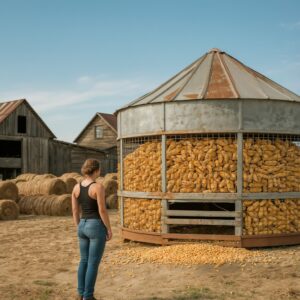
I grew up on a sweet potato farm about ten miles outside of town, where mornings started before the sun and “vacation” meant the county fair. The smell of damp earth and coffee brewing in the kitchen was my alarm clock. Our rooster, louder than any iPhone, announced the day, and my parents — with dirt already under their nails — moved with a steady purpose that made the world feel solid.
I used to think that kind of grit was enough to earn anyone’s respect.
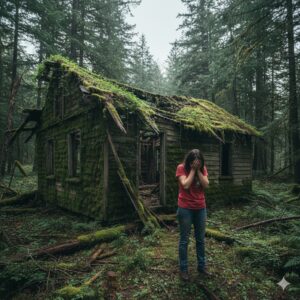
Then came the scholarship. A full ride to a private high school in the city. Everyone called it my “big break.” But on my first day, stepping into homeroom with jeans that still faintly smelled of the barn, I caught the curl of a glossy ponytail as the girl in front of me leaned toward her friend and whispered, “Ew. Do you live on a farm or something?”
I didn’t answer. Just sat down and stared at my desk like maybe if I kept my head low enough, I could disappear.
I told myself I was imagining things — but the comments kept coming, light as feathers but sharp as tacks.
“What kind of shoes are those?”
“Wait, so you don’t have Wi-Fi at home?”
One guy grinned and asked if I rode a tractor to school.
So I said nothing. I studied hard. I never mentioned home. But each time I swallowed those words, I felt a little more hollow.
Because back home, I wasn’t “that farm girl.” I was Mele. I could patch a tire, wrangle chickens, and haggle with customers at the produce stand like a pro. My parents had built something real, acre by acre, with their hands and their faith. Why was I letting a few raised eyebrows convince me to hide that?
The turning point came in the form of a school fundraiser. Each student was supposed to bring something from home to sell. Most kids brought neatly wrapped cookies or crafts their nannies had probably helped them make. I brought sweet potato pie — our family’s recipe, the one that had won two ribbons at the fair. I baked six. By the time I went to grab lunch, they were gone. Twenty minutes. Sold out.
That’s when Ms. Bell, the guidance counselor, sidled up beside me. She was halfway through telling me, “This pie? This is you, Mele. You should be proud to share more of—” when someone interrupted.
I turned — and nearly forgot how to breathe.
It was Izan. The guy everybody liked, not because he was loud or flashy, but because he carried himself like he didn’t need to prove anything. His dad was on the school board, his sneakers looked like they’d never seen a speck of dust, and somehow, he remembered everyone’s names. Including mine.
“Hey, Mele,” he said, glancing at the stack of empty pie plates. “Did you really make those yourself?”
I nodded, still not sure if I should be nervous or proud.
He grinned. “Think I could get one for my mom? She’s obsessed with anything sweet potato.”
I blinked twice before finding words. “Uh… yeah. Sure. I can bring one Monday.”
Ms. Bell shot me a little told you so smile.
That night, lying in bed, I wasn’t thinking about Izan. I was thinking about all the times I’d hidden my roots like they were a stain instead of a strength. What if, instead of shrinking, I leaned in?
So Monday, I didn’t just bring one pie. I brought flyers. “Mele’s Roots” in big letters, followed by: Farm-to-table pies, fresh every Friday. Ask about seasonal flavors.
I figured maybe two or three kids would order. By the end of lunch, I had twelve pre-orders and a DM from a girl named Zuri asking if I could cater her grandma’s birthday party.
From there, it snowballed. Teachers wanted mini pies for staff meetings. One girl offered me a designer jacket in exchange for three pies. (I said no — respectfully. Also, it was ugly.)
But my favorite moment was when Izan sent me a picture of his mom, fork mid-bite, eyes wide. The caption read: She says this is better than her sister’s — and that’s a big deal.
I laughed so loud my dad looked up from the table. “That good or bad?”
“Very good,” I said. “I think we might be expanding.”
Thursday nights became baking nights. Pies, biscuits, bread — my parents teaching me the little tricks they never thought to write down. I learned to roll dough by feel, not measurement. And somewhere along the way, I started weaving those stories into school essays and presentations — talking about the land, my grandparents, the drought years, the harvests that felt like miracles.
People started listening.
Even the girl with the glossy ponytail asked me for a recipe. I gave her a simplified version — no wood-fired oven instructions — but it felt like a quiet victory.
By senior year, our final project was to showcase something that shaped our identity. I made a short film about our farm: my mom washing carrots in a tin bucket, my dad tossing bread crusts to the dogs, the wind moving in waves across the sweet potato rows. I ended it with me at the county fair, standing beside my pie stall under a hand-painted sign.
When they played it in front of the whole school, my stomach churned. I stared at the floor the whole time. Then the clapping started — slow at first, then louder, until some people stood.
Afterward, Izan found me in the hallway. Gave me a quick side hug and said, “Told you your story mattered.”
I smiled. “Took me a while to believe it.”
The truth is, I used to think people wouldn’t respect me if they knew where I came from. Now I know — you teach people how to see you. When you own your story, it becomes your power, not your shame.
So yeah. I’m a farmer’s daughter. That doesn’t make me less.
It makes me rooted.