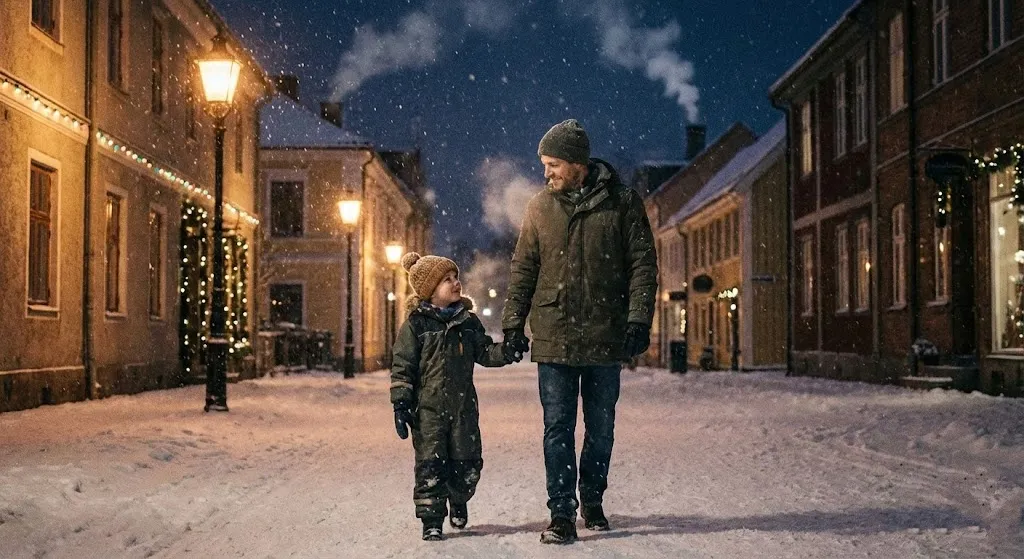
Leo Blake held his father’s hand tightly as they exited the grand ballroom of the Blackstone Hotel.
The building glowed behind them, golden lights spilling across the sidewalk. Men in suits laughed loudly near the valet. Women in glittering gowns snapped photos under crystal chandeliers. The smell of champagne and expensive perfume still lingered in Leo’s nose.
His father, Brian Blake, didn’t pause. He was already on the phone, one hand in his coat pocket, the other guiding Leo down the marble steps.
“Yes, we can close by Monday,” Brian said into his Bluetooth earpiece. “Have the documents at my office first thing.”
Leo looked up at him but didn’t say anything. In his small hand, he clutched a worn little plush lion—something that didn’t belong in this polished world, something that used to live in a different house, with a different voice that read stories and sang lullabies.
They turned onto a side street that had lost its lights. It was quieter, colder. Puddles reflected dim signs from a closed coffee shop. Leo walked slower; something tugged at him. Then he heard it. A soft voice, almost drowned by wind.
You are my sunshine, my only sunshine.
He stopped. Just ahead, near the edge of a shuttered storefront, a woman sat hunched over a worn stroller. Her blonde hair was tied back loosely, strands falling across her cheek. Her coat was too big, fraying at the sleeves, and her hands were pale, moving carefully over something inside the stroller.
Leo blinked. It was not a baby. A small, old teddy bear lay wrapped in a faded blanket. The woman was shielding it from the wind, murmuring softly as though it were alive.
Brian caught the change in pace. He glanced sideways, quickly, and then turned his eyes away. His grip on Leo’s hand tightened.
“Don’t stare, Leo,” he said, his voice sharp. “Keep walking.”
Leo resisted slightly but let himself be pulled forward. Brian didn’t look back. In his mind, he categorized the woman immediately: young, unkempt, mentally unstable, likely intoxicated. Another social problem someone else would deal with. Not his concern. He had given his check to the charity tonight. He had done his part.
Still, something about the song bothered him. He shook it off. “I’m tired. It’s been a long day.”
Leo glanced over his shoulder again. The woman leaned forward, whispering, “Shh, sleep, baby.” Her hand brushed gently over the teddy bear’s head.
The words hit Leo’s chest like a memory. That voice. That whisper. That was how his mother used to soothe him. Not just the song, but the exact cadence, the way the shh floated into the air like a kiss goodnight. He stopped walking.
“Dad,” Leo said, his voice small but certain. “That’s Mom.”
Brian froze. For a moment, the street went completely silent in his ears. He turned slowly, eyes locking onto the woman behind them. She was still seated, eyes down, lips moving to the end of the verse. The streetlight flickered above her, casting shadows that made her face harder to read.
But Brian saw it. The slope of her jaw. The color of her hair. And the faint, uneven line across her right cheek. A scar.
A part of him staggered inside. “No,” he said out loud, more to himself than to Leo. “That’s not possible.”
He crouched slightly to meet his son’s eyes, trying to stay calm. “Leo, your mom is gone. You know that.”
Leo didn’t blink. He looked back toward the woman, his voice even quieter. “She’s not gone. She’s just… not home yet.”
Brian opened his mouth to speak, but nothing came. Instead, his gaze drifted once more to the woman and her small, ragged teddy bear. She looked up just then, only for a second, and her eyes—tired and distant—brushed past him like a ghost who didn’t recognize her own name.
Brian straightened up, clearing his throat. “Come on,” he said quickly. “Let’s go.”
But this time, he didn’t pull Leo. He just stood there. And in the pause, in the unsettled breath between one step and the next, something in him, solid and logical for so long, began to crack. Just a little.
The morning came with wind that cut through layers of worn fabric. Donna sat curled at the edge of a shuttered bakery, her arms wrapped around a faded stuffed bear resting inside a secondhand stroller. The wheels squeaked slightly every time she moved it back and forth—a gentle, rhythmic motion, soothing and maternal.
“Leo’s cold today,” she murmured, tightening the scarf around the bear’s frayed neck. “We’ll find a warmer spot soon, baby. Mommy promises.”
Her voice was soft. She never spoke loudly. Voices drew attention, and attention brought eyes. She hated eyes. Eyes didn’t see her. Not really. They looked through her when they weren’t judging. She knew what people thought: crazy, dirty, useless.
But she wasn’t crazy. She just… didn’t remember everything. She didn’t remember where she came from, or why her stomach ached most mornings with something other than hunger. She only knew the world had become a place of shadows, and the only light left was Leo.
The Leo she fed small spoonfuls of oatmeal to. The Leo she cradled gently during afternoon naps. The Leo who never cried, never fussed, and always listened. The Leo that was just a bear.
Still, she called him “my boy.” Sometimes, strangers dropped coins at her feet or offered half-eaten sandwiches. She accepted with gratitude, always polite. “He’s hungry too,” she’d say, and tear the crust into tiny pieces, placing one gently into the stroller as if it might be eaten later.
But she never begged. Never asked. That wasn’t what mothers did. They waited. They watched. They protected.
She sang. That was how she remembered him. Her real Leo, though the image in her mind was blurry, like fogged glass. A small boy, warm against her chest. His fingers curled in her sweater, his breathing slowing under the sound of her voice.
You are my sunshine, she would sing, almost whispering.
One night, after the rain began, Donna found shelter beneath the metal stairs behind a closed pharmacy. The space was narrow and damp, but dry enough. She bundled Leo, the bear, in her arms, covering him with the same patchy blanket she always used. Then she sang.
You make me happy when skies are gray.
Her voice trembled. Notes cracked from the cold in her chest. But she finished the verse; she always did. Afterward, she leaned down, pressing her lips gently to the bear’s worn fabric forehead.
“Mommy’s here,” she whispered. “Don’t be scared.”
She closed her eyes, rocking slightly. And for a moment, she wasn’t cold, wasn’t broken, wasn’t invisible. She was just a mother, waiting.
That same night, Brian couldn’t sleep. He lay in bed beside his wife, Lisa, who had turned off the lamp and slipped into her usual silence. They never talked much at night. They barely talked at all lately…
But his mind wasn’t on her. It was on the voice. That woman’s voice. It clung to him—soft, trembling, hauntingly familiar. He didn’t want to believe it. It made no sense. But it sounded like her: the same pitch, the same lingering note at the end of “sunshine.”
He got up, padded barefoot across the cold floor, and opened his laptop. Old videos. He clicked.
The screen filled with the gentle chaos of a first birthday. Balloons, cake-smeared fingers, and laughter. In the middle, she sat on the couch, blonde hair falling around her face, holding baby Leo against her chest.
You are my sunshine.
Same key, same phrasing, same soft vibrato on please don’t take my sunshine away.
Brian’s breath caught. He paused the video and leaned back, stunned. “No,” he whispered.
But something inside him shifted. He opened the old accident report, files he hadn’t read in years. The night Donna’s car had crashed on the icy bridge, they never found her body—just twisted metal and broken glass on the passenger side. Blood, a burnt coat, presumed dead. But not confirmed. She had been driving alone. He hadn’t been there.
His stomach turned. A detail blinked at him from the corner of the report: Burn pattern consistent with passenger side glass rupture.
A scar. The woman on the street had a scar, just like that.
Brian shut the laptop slowly. He couldn’t say it out loud yet. But the thought screamed inside him. What if she’s not gone? What if Donna’s alive? And what if he’d walked past her without even knowing?
Leo lay on his bed, small fingers wrapped tightly around the faded stuffed animal pressed to his chest. The ceiling above him was painted in soft shadows from the hallway light, but his mind was somewhere far away. He wasn’t sleepy. Not really. His eyes blinked slowly as his memory played a familiar melody in his head, like a dream he couldn’t fully wake up from.
You’ll never know, dear, how much I love you.
The voice wasn’t loud. It was warm, close. He remembered the sound and the feeling that always came with it: his mother’s arms pulling him close, the gentle rhythm of her hand patting his back when he coughed, and the soft scent of her hair when she bent down to kiss his forehead. He could almost feel her lips brushing his skin, the way her voice dipped just slightly on, please don’t take my sunshine away.
He remembered all that. But her face? It was like trying to hold water. The harder he tried to picture it, the more it slipped away. Blurry. Gentle. Safe. But not clear.
Leo sat up slowly, grabbing his box of crayons from the shelf beside his bed. He pulled a piece of paper from his desk and began to draw with quiet concentration. A woman, sitting cross-legged on a rug, holding a small boy. He gave her a green sweater. He wasn’t sure why, but it felt right. He added soft yellow hair that fell across her shoulders, her arms wrapped around the little boy, and a teddy bear. Not the one he held now, but the one in the stroller that day, the ripped one. The one she had sung to.
He pressed the crayon harder now, outlining her smile. It wasn’t big; it was gentle.
Later that evening, Lisa passed by Leo’s room. The door was open just enough for her to peek in. He wasn’t sleeping; he was sitting on the floor, finishing a drawing. She stepped inside softly.
“Hey buddy,” she said, crouching down. “What are you working on?”
Leo looked up briefly, then held up the picture. His face was calm but serious. Lisa smiled faintly. “Is that me?”
Leo paused, shaking his head once. “That’s Mom,” he said quietly. “My first mom.”
Lisa blinked.
“Oh, she’s not dead,” Leo added after a pause. “She’s just lost.”
The words settled into the air like falling snow. Lisa stood still, her hands relaxed at her sides, but her mouth didn’t form a reply. She looked at the picture again, then stepped back gently.
“I see,” she said softly. “That’s… beautiful.” She left without another word.
The next day, Brian sat behind the wheel of his car, engine idling, hands gripping the steering wheel tighter than necessary. The street ahead was dim; cold wind whistled between rusted fences and the metal bones of the old train tracks. He had told himself this was just curiosity, just caution, but his heart was pounding.
He saw her. Across the street, near a wall of graffiti, the woman was sitting on a crate beside a torn stroller. She was alone, her head bowed, blonde hair dull under the orange streetlight. She reached into the stroller, brushing her hand slowly over the fur of a stuffed bear.
And then, she did something that made his throat tighten. She smoothed the bear’s hair with her fingers, the exact same way Donna used to smooth Leo’s when he fell asleep in her lap.
Brian’s breath caught; his grip loosened on the wheel. He stepped out of the car, hesitating for a moment before walking forward slowly. As he approached, she turned her head.
The light hit her face. A pale scar, faint but visible, ran from the edge of her cheekbone to just above her temple. Her eyes met his—startled, fragile, searching. And even in their confusion, even in their emptiness, something familiar stirred.
Brian stopped in his tracks. His lips parted, his voice barely escaping. “Donna?”
The woman looked at him, unsure, then lowered her eyes quickly. But Brian didn’t move. Because for the first time—not in memory, not in video, but in flesh—he was no longer sure this was a stranger. For the first time, he dared to believe.
It was just past dusk when Brian returned to the street he couldn’t forget. The city lights hadn’t yet touched the corners of this quiet block; only a dim flicker from an old convenience store sign blinked somewhere down the street. The cold air bit at his face, but he barely noticed. In his hands, he held a single paper cup, steam rising faintly from the lid.
This time, he wasn’t in a suit. No polished shoes, no heavy cologne—just a grey wool coat and a scarf loosely draped around his neck. This wasn’t the version of himself people met in boardrooms. This was someone else, a man with questions and a hope he was almost afraid to name.
He spotted her in the usual place, sitting on the curb beside the rusted stroller: same coat, same messy hair, same bear in her arms. She was murmuring softly, rocking slightly, not noticing him at all.
Brian stopped a few steps away, crouched slowly, and placed the cup of tea on the pavement between them. He didn’t slide it too close, just far enough that she could reach it if she wanted…
She didn’t. Donna’s arms were locked tight around the tattered, stuffed bear. Her fingers gripped its cloth ear; her eyes didn’t lift. Her body seemed folded in on itself, small and motionless except for the slight twitch of her thumb stroking the corner of the blanket tucked around the bear.
Brian stayed crouched, not moving closer. “I used to know someone,” he said softly, “who sang that song.”
Donna’s shoulders stiffened just a little. Her head tilted slightly as if she heard something familiar in his voice, but she didn’t speak. Her eyes flicked toward him just for a second, then dropped again to the sidewalk.
Brian waited, then asked carefully, “Do you… have a son?”
For a moment, nothing. Then she nodded, barely.
“Yes,” she whispered. “His name is Leo.”
It was a whisper soaked in memory—half certain, half dreaming. Brian felt his chest tighten, a strange, trembling breath catching in his throat. His heart kicked hard against his ribs. He hadn’t expected her to answer, not like that, not with that name.
He didn’t speak; he couldn’t. His hand slowly pressed against his chest, steadying his breath as the name echoed in his head like a bell ringing through fog. Leo. No one knew that. No one out here, no one in this world she lived in now.
The silence stretched between them. Donna still hadn’t looked at him fully. She stared at the bear, rocking it again, whispering words too soft to catch.
“I lost him,” she said suddenly, her voice raw and distant. “But I hear him in my sleep.”
Brian watched her lips tremble. She wasn’t crying, not exactly, but something inside her was splintering.
“He cries,” she continued, more to the bear than to Brian. “And then it stops. Every night. Like a ghost.”
Her breath hitched. She began to tremble, shoulders curling inward like she was bracing against something no one else could see. Panic, not loud but deep. A tremor working through her hands, her chest, her voice.
Brian didn’t move closer. He didn’t reach out.
“I don’t want to scare you,” he said gently. “I just…” His voice caught. “He’s not a ghost. He’s very real. And he misses you.”
Donna blinked, her fingers pausing against the bear’s fabric. Her eyes, still lowered, seemed suddenly wet. But she didn’t speak again.
Brian stood slowly, watching her for a moment longer. Then he took one step back, just one.
“I’ll come back tomorrow,” he said, “if that’s okay.”
No answer. But her grip on the bear loosened, just slightly. And as he walked away, the cup of tea still sat between them, untouched but no longer ignored.
The apartment was small but warm, tucked into a quiet corner of the city far from the cold sidewalks where Donna had been living. Brian had arranged everything: an on-call nurse, gentle lighting, soft bedding, and a stocked kitchen with chamomile tea and honey. Nothing grand, nothing overwhelming—just safety, peace.
Donna sat on the edge of the bed, hands folded tightly in her lap. She hadn’t spoken much since arriving, only nodded quietly when shown around. Her eyes moved slowly over the room, pausing at the bookshelf filled with children’s stories and the extra blanket draped neatly over the armchair.
Brian stood nearby, not too close. He didn’t say much either. For now, silence felt more honest than words.
The next afternoon, Leo arrived, his small backpack slung over one shoulder and a stuffed bear cradled in his arms. It was frayed at the ears, with one button eye hanging by a thread, but he held it like it was made of gold. He stepped into the apartment slowly, eyes scanning every corner.
Then he saw her. Donna was sitting by the window, sunlight catching the pale strands of her hair. She looked up as the door opened. Their eyes met.
She didn’t recognize him. Not yet. Her expression stayed calm, polite even, but blank, until Leo walked forward, saying nothing, and gently placed his bear beside hers on the bed.
Two bears, nearly identical.
Donna stared, her breath caught in her throat. Her hands lifted, trembling, and hovered above the two toys before finally settling on them, one in each palm. She ran her fingers over the familiar fabric, the matching stitched smiles, the worn-out seams.
Something shifted in her chest—a warmth, a pull. Her voice came out in a whisper. “Why? Do I feel like I know you?”
Leo didn’t answer. He just stepped forward, and in that small, certain way only children can manage, he wrapped his arms around her.
She froze. Then, slowly, achingly, she returned the embrace. Her arms folded around his small body, and her face buried into his shoulder. Her body began to shake. No words, no sound, just the kind of silent weeping that rises from something deep and old and long buried.
Brian stood in the doorway, watching, his throat tight, eyes glassy. It wasn’t a perfect reunion, not yet, but it was real, and it was beginning.
That night, Donna slept in the bedroom for the first time. Curled under the quilt someone had knit by hand, the stuffed bears were tucked beside her on the pillow. In the living room, Brian sat quietly on the couch, listening to the soft hum of the heater, the occasional sound of cars passing below.
At some point, a small cry came from the bedroom. Not loud, not panicked, just a single name. “Leo.”
She didn’t know she’d said it out loud. Inside the room, Donna stirred in her sleep. Her body jerked lightly, her forehead damp; her breath came faster.
Then, the memories came. Flash after flash. A car. Headlights. The screech of tires. Her arms reaching out. A child’s voice crying, Mommy. The sound of glass. Then silence. Darkness. And after that, nothing. Until now.
She woke with a gasp, sitting bolt upright. Her hand clutched the blanket like a lifeline. Her eyes were wide, wet, frantic. Then her gaze fell on the two bears beside her. Her chest broke open.
“Leo,” she whispered again, her voice cracking. “My Leo. Oh my God.”…
The dam inside her gave way. And this time, she didn’t cry like someone lost. She cried like a mother remembering the sound of her child’s voice. From the hallway, Brian heard it, and for the first time in five years, he let the tears fall too.
The results came back on a Thursday morning. Brian sat alone at his desk, the envelope resting under his fingers like a weight he hadn’t prepared for. He didn’t need to open it, not really. He already knew. He had known the moment she whispered Leo’s name with that ache in her voice only a mother could carry.
Still, seeing it in ink made something in him finally exhale. Donna Bennett is the biological mother of Leo Blake.
He leaned back in his chair, eyes fixed on the ceiling, the edges of his vision blurring. It was no longer a question of if; it was now what.
That evening, Brian returned home to the quiet apartment he shared with Lisa. She was sitting on the couch, reading. She looked up when he entered, and something in her expression told him she already knew. Maybe it was the way his face had changed, or maybe she’d seen it coming long before he did.
He sat across from her, clasping his hands. “I need to talk to you.”
Lisa closed her book slowly. “It’s her, isn’t it?”
Brian nodded. “Yes, she’s Leo’s mother.”
Lisa’s gaze softened, not with sorrow, but with understanding. “And she was yours, too.”
He didn’t deny it. They had both known this marriage wasn’t built on love. It had been comfort, companionship—something quiet they reached for in the aftermath of separate griefs.
Lisa leaned forward, resting her elbows on her knees. “You were always halfway somewhere else, Brian. I didn’t resent it. I just… hoped maybe we could grow into something steady.”
“I’m sorry,” he said, his voice barely audible.
She gave a sad smile. “Don’t be. Go where your heart never left.”
She stood, kissed him once on the forehead, and walked away without packing bags or slamming doors. Just… gone. And it was the kindest goodbye he had ever received.
The next morning, Brian knocked gently on the apartment door where Donna was staying. She was sitting by the window, her hair pulled back, looking stronger than she had days ago, though a quiet nervousness flickered behind her eyes. When she saw him, she stood but didn’t come closer.
“I know,” she said before he could speak, “about the test.”
He nodded. “It’s real.”
She smiled, but it didn’t reach her eyes. “I guess that means I really existed. At least… to someone.”
Brian took a careful step forward. “Donna.”
But she raised her hand gently. “I’m not the same woman you loved,” she said, her voice calm, steady. “I don’t even know if I’m her anymore.”
He looked at her, truly looked—at the scar on her face, the softness in her posture, the fear she tried to hide behind quiet strength.
“No,” he said slowly. “You’re not the same, and neither am I.”
She swallowed hard.
“But you’re still Leo’s mom,” he continued. “And you’re still the woman I waited for. I just didn’t know I was still waiting.”
Donna blinked, lips trembling slightly. “I don’t have a map back to who I was,” she whispered. “I’m afraid of being someone new, of being someone not enough.”
“You don’t have to be her,” he said. “You just have to be here, with us.”
There was a long silence. Then she stepped forward, and he took her hands into his. They were small and cold, but they didn’t pull away.
“We’re a mess, Brian,” she said quietly.
He smiled through the thickness in his throat. “I know. But we’re our mess.”
Later that night, Brian found Leo curled up on the couch, drawing. He looked up as Brian entered. “Did she remember me today?” Leo asked.
Brian sat beside him. “She’s remembering more every day.”
Leo nodded, satisfied. Brian wrapped an arm around his son. “We’re going to be okay,” he said softly. “Not perfect, not easy, but together.” And that was enough.
The mornings began slowly now. Donna would wake to the sound of soft sunlight filtering through the curtains—not alarms or street noise, no sirens, no cold concrete floors, just warmth and the rhythmic ticking of a small wall clock she had grown to trust.
Once a week, she sat in a quiet room with a therapist named Marla. They talked, sometimes in words, sometimes just in silence. It was strange at first—naming things, saying “trauma” out loud, owning a grief she hadn’t even fully remembered. But piece by piece, the fog started to lift.
Between sessions, Donna learned how to live again. She burned rice the first time she tried cooking on her own, then laughed until she cried. She watched YouTube tutorials on folding shirts properly. She wrote in a plain leather journal, one line a day.
Today, I smiled without guilt….
Today, I laughed with Leo.
Today, I didn’t feel broken.
The apartment was modest—two bedrooms, pale blue curtains—but to her, it felt like a palace. There were photos on the fridge now: blurry ones of Leo with spaghetti sauce on his face, candid shots of Brian holding two cups of hot cocoa, smiling in a way she hadn’t seen in years.
The piano sat near the window, slightly out of tune. Old ivory keys yellowed at the edges. She hadn’t touched one in years. The first time she sat down, her hands trembled, but they found their way.
You are my sunshine. My only sunshine.
Her fingers stumbled on the second verse. Her voice cracked, but she kept going. And when she looked up, Leo was standing by the door, holding his bear, listening. He didn’t speak. He just smiled.
Leo had a project, one he didn’t tell anyone about. It started with a shoebox, then a few sheets of paper, a glue stick, markers. He called it his time capsule.
Inside, he placed a photo of his mom holding him at the hospital, still tired but beaming; a drawing he’d made last week; three figures standing under a big tree—one had long yellow hair; his mom’s old teddy bear, the one she’d once treated like him when she couldn’t remember; and a folded note in his handwriting, printed carefully: Mom didn’t die. She just got lost, and now she’s home.
He taped the box shut and placed it under his bed. Not to forget, but to always remember how far they’d come.
That evening, Donna stood in front of the mirror. For the first time in five years, she didn’t look away. Her reflection wasn’t perfect. The faint scar still curved along her cheek. Her eyes held more weight than they once had. But the woman looking back wasn’t broken. She was healing.
She wore a pale blue dress she had kept all these years in a forgotten bag—wrinkled, a bit faded, but still hers. She ran a brush through her now longer hair, letting it fall past her shoulders. Brian passed by the door and paused. He didn’t say anything, just looked at her like it was the first time he’d seen her in years.
She turned toward him, smiling shyly. “It’s just a dress.”
“No,” he said gently. “It’s not just anything.”
Donna took a breath, and for the first time, it felt like air filled her completely. There was still work to do, more therapy, more hard days. But for now, there was music, there was laughter, there were pancakes with too much syrup, and bedtime stories with Leo curled into her side. For now, there was life, and she was living it.
The hall shimmered with soft candlelight. Golds and creams dressed the room, but nothing drew the eyes more than the white piano at center stage, and the woman sitting behind it. Donna.
She wore a simple, elegant blue dress. Her hair, grown out and softly curled, framed her face with quiet grace. The faint scar on her cheek was still visible, but tonight, it didn’t define her. It was simply part of her story.
Leo sat in the front row, his small hands gripping Brian’s. He leaned forward just slightly, eyes wide, heart full. He knew this moment mattered.
And then, Donna began to play. The first notes of “You Are My Sunshine” rang out, clear and calm. But it wasn’t the lullaby of old. Not exactly. Her fingers moved with more strength now, more certainty. Her voice when it came in was steady. Not perfect, but true.
You are my sunshine. My only sunshine. You make me happy when skies are gray...
The hall went completely still. It wasn’t just a song anymore. It was survival. It was motherhood. It was forgiveness—for herself, for the years lost, for the pain endured in silence.
People in the crowd wiped their eyes quietly. Some had read her story in the paper weeks ago: “Missing mother found after five years of silence.” But hearing her sing—that made it real. She wasn’t a headline. She was a heartbeat, beating again.
As the last note faded, Donna stood and gave a small bow. No one clapped at first, not out of disrespect, but because it didn’t feel like a performance. It felt like a prayer. Then, slowly, the applause came—gentle, growing, and rising into a standing ovation.
Outside the hall, the rain had started—soft and misty, the kind that blurs city lights and slicks sidewalks. Leo ran ahead, hopping between puddles, arms out like wings. Brian opened the umbrella, paused, and folded it shut again.
Donna raised an eyebrow, amused. “Wasn’t that the whole point of bringing it?”
He smiled. “We don’t need it.”
She glanced up at the sky. Water tapped her face. Not cold. Not unwelcome.
Leo spun around and called, “Dad! Mom! Hurry up!”
Brian reached for her hand. Donna took it. And together, they stepped into the rain. No one hurried. No one looked away. People passed them on the sidewalk. Some paused, recognizing Donna. Others simply nodded at a family walking home in the drizzle. To the world, they looked ordinary. But to them, every drop felt like grace.
For years, they had all been running—from memory, from pain, from truth. But not anymore. Now they walked through it, steady and side by side.
Brian glanced down at Donna. Her eyes were closed for a moment, face turned toward the sky. Peace. He hadn’t seen that on her face in half a decade. And Leo, soaked but grinning, ran back to take both their hands.
In that moment, Brian thought, we don’t need umbrellas anymore. Because now, none of us are hiding.
And under the soft glow of the streetlights, their footprints disappeared behind them, washed clean by the rain, but never erased. Just like them. Still here. Still walking. Still together.