The gravel dug into my cheek, a million sharp little teeth biting into my skin, but that pain was distant, muted by the shockwave that had just shattered my spine. Above me, the summer sky of suburban Ohio was a blinding, indifferent blue.
“Walk it off, stop being a baby,” my wife, Jessica, shouted. Her voice didn’t sound like the woman I had married five years ago; it was sharp, jagged, cutting through the humid air like a serrated knife.
We were in the backyard of her parents’ house, a sprawling, manicured lawn in Oak Creek, celebrating her sister Emily’s thirty-fifth birthday. Just five minutes ago, the air had been filled with the generic hum of a family gathering—The Rolling Stones playing tinny and distorted from a cheap Bluetooth speaker, the hiss of beer bottles opening, the smell of charcoal and marinade. I had been trying, as I always did, to earn my place in a family that treated me like a temporary fixture.
“I’ll get the big cooler from the deck,” I had said.
I remembered the weight of the cooler in my hands, the condensation slick against my palms. I remembered turning to descend the wooden stairs. And then, I remembered the sound.
It wasn’t a snap. It was a detonation. A dry, sickening crack that echoed inside my skull like a gunshot. My body pitched forward, the horizon spun violently, and the ground rushed up to meet me.
Now, I lay twisted at the bottom of the stairs. The cooler lay on its side, ice cubes scattered in the grass like diamonds, melting in the heat.
“Come on, Mark,” Jessica said, stepping into my field of vision. She looked down at me not with concern, but with impatient embarrassment. She crossed her arms, her knuckles white. “You’re making a scene. Emily is watching.”
I tried to push myself up. My brain sent the command: Stand up. Get off the grass. Apologize.
My arms shook as I pressed them against the earth. But below my waist, there was… silence.
It wasn’t numbness. It wasn’t pins and needles. It was a terrifying void. It was as if my body simply ended at my ribcage.
“I… I can’t,” I stammered, the air struggling to leave my lungs.
Ryan, Jessica’s older brother, stepped up beside her. He held a bottle of Bud Light loosely in one hand, a smirk playing on his lips. Ryan had never liked me. To him, I was the soft data analyst who wasn’t “man enough” for his sister.
“Dramatic much?” Ryan laughed, a harsh, barking sound. “You slipped, dude. It’s three steps. It’s not like you fell off a roof. Get up.”
Emily joined the semi-circle of judgment, holding a half-eaten hot dog. “Unbelievable,” she muttered, rolling her eyes. “This is my birthday. Why do you always have to make things about you, Mark? It’s pathetic.”
I opened my mouth to scream at them, to tell them that something was horribly, irreversibly wrong, but panic had seized my throat. I stared at my legs. They looked like foreign objects, clad in denim, belonging to a mannequin.
“I can’t move my legs,” I whispered.
Jessica let out a loud, theatrical sigh. “You’re fine. Stop acting like a child and stand up.”
I grit my teeth, straining every muscle in my core, trying to force a twitch, a tremor, anything. Nothing.
That was when Karen pushed through the crowd.
Karen was the next-door neighbor, a woman in her fifties with graying hair and eyes that had seen too much. I knew she was a paramedic with the county fire department. She didn’t have a drink in her hand. She dropped to her knees beside me, her movement fluid and professional.
“Don’t move,” she commanded, her voice cutting through the family’s jeers. She placed a firm hand on my shoulder to stabilize me. “Mark, look at me. Stay still.”
She moved her hand down to my leg. She squeezed my thigh.
“Can you feel that?” she asked.
“No,” I rasped.
She moved to my foot. She dug her thumbnail into the arch of my sneaker, pressing hard enough that I should have yelped.
“How about that?”
“No,” I whispered, tears finally spilling over. “Karen, I can’t feel anything.”
Karen’s jaw tightened. The professional mask slid into place, but I saw the flicker of alarm in her eyes. She looked up at Jessica and Ryan, her voice dropping an octave, becoming steel.
“Call 911. Now.”
“Oh, for God’s sake, Karen,” Ryan scoffed. “He’s faking it for attention. He just—”
“I said call 911!” Karen roared, turning on him with a ferocity that silenced the backyard. “He has no sensation below the T-line. This is a spinal injury. Make the call, or I will, and I’ll report you for negligence.”
The backyard went dead silent. Ryan’s smirk evaporated. Jessica’s face drained of color, not from concern, but from the realization that her “inconvenience” was about to become a spectacle.
As the distant wail of sirens began to pierce the afternoon air, Karen leaned in close to my ear. “Stay with me, Mark. Keep breathing.”
When the ambulance crew arrived, they worked with controlled chaos. A backboard was brought out. A cervical collar was snapped around my neck. As they prepared to lift me, Karen pulled the lead paramedic aside. I couldn’t hear everything, but I saw her gesture toward the stairs, then toward me, and then she pointed a finger directly at Ryan.
The paramedic nodded grimly. He walked back to the stretcher, looking at his partner.
“Radio dispatch,” he said, his voice low but audible. “We need police backup at this location. Possible assault.”
Jessica gasped. “Police? Why would we need police? He fell!”
I stared up at the canopy of trees, the leaves shimmering in the sunlight, unaware that the flashing lights reflecting in my eyes were signaling the end of my life as I knew it.
As they slid me into the back of the ambulance, the doors closing on my wife’s panicked face, I realized I couldn’t remember exactly how I lost my balance. But I did remember one thing—just before the step snapped, I hadn’t slipped. I had been pushed.
The St. Jude’s Trauma Center smelled of antiseptic and cold fear. I lay flat on a gurney, staring at the ceiling tiles as they rushed by, a blur of white and gray. Doctors and nurses swarmed around me, their voices a cacophony of medical jargon—compression, lumbar, reflex response.
They cut my clothes off. They rushed me through X-rays. Then, the MRI machine swallowed me whole.
For forty-five minutes, I lay inside that magnetic coffin, the loud mechanical pounding echoing in my skull like a construction crew dismantling my life. Thunk. Thunk. Whir. With every beat, the reality set in. I wasn’t waking up from this.
When I was finally wheeled back to a private room, Jessica was there. She was sitting in the corner chair, scrolling on her phone. She didn’t look up when the nurses transferred me to the bed. She sighed, tapping a long acrylic nail against the screen.
“Finally,” she muttered. “My mom is blowing up my phone. Everyone is freaking out.”
“I’m sorry,” I said automatically. The habit of apologizing to her was so ingrained that even now, paralyzed and terrified, I was saying sorry for ruining the party.
“Do you know how embarrassing this is?” she hissed, standing up. “Ryan is furious. You made him look like a jerk in front of the neighbors.”
Before I could answer, the door opened. A man in a white coat entered, followed by a neurologist I didn’t recognize. This was Dr. Alan Peterson, the trauma surgeon. His face was a mask of professional gravity.
“Mark,” Dr. Peterson said, ignoring Jessica. “I’m Dr. Peterson. We’ve reviewed your scans.”
Jessica stepped forward. “So, he needs surgery, right? You fix it, and we can go home in a few days?”
Dr. Peterson turned to her, his eyes cold. “Mrs. Miller, your husband has suffered a severe spinal cord injury at the T12 level. There is significant compression of the cord and internal bleeding.”
He turned back to me. “Mark, the vertebrae have shattered. Bone fragments are pressing on the nerves. We need to operate immediately to stabilize the spine and remove the pressure.”
“Will I walk again?” I asked. The question hung in the air, heavy and suffocating.
Dr. Peterson hesitated. That hesitation told me everything. “The damage is severe. The surgery is to prevent further loss of function and to stabilize your back. As for walking… it is highly unlikely.”
The room spun.
Jessica let out a nervous, high-pitched laugh. “That’s ridiculous. He fell down three wooden steps. People don’t get paralyzed from three steps.”
The neurologist, a sharp-eyed woman named Dr. Evans, stepped forward. She tapped a tablet in her hand. “That’s actually what we wanted to discuss.”
She turned the screen so we could see the grayscale image of my spine. “This fracture pattern,” she said, tracing a jagged line on the screen. “It’s a burst fracture. Usually, we see this in high-velocity impacts—car crashes, falls from significant heights.”
My stomach tightened. “What are you saying?”
“I’m saying,” Dr. Evans said carefully, “that the force required to do this damage is inconsistent with a simple slip and fall. The angle of the impact suggests a strong, accelerated downward force applied to the upper back.”
She paused, looking directly at me. “Almost like a shove.”
The silence in the room was absolute. The hum of the air conditioning seemed to roar.
“That’s insane,” Jessica snapped, her voice trembling. “Nobody shoved him. He’s clumsy. He tripped.”
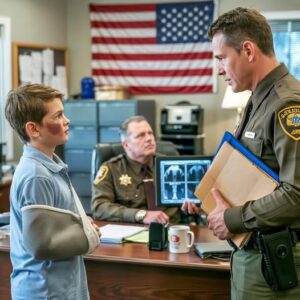
At that moment, a heavy knock rattled the door. It swung open, and two uniformed police officers stepped in. The older one, a man with a thick mustache and a badge that read Officer Brooks, took off his cap.
“Mr. and Mrs. Miller,” Brooks said. “We’re here to take a statement regarding the incident at 420 Oak Lane.”
Jessica stepped between the bed and the officers. “This is a hospital. My husband is hurt. You can’t be here.”
“Actually, ma’am,” Brooks said, his voice level but firm. “We’re here because the paramedics and the attending physician flagged this as a suspicious injury. We need to speak to your husband alone.”
Jessica looked at me, her eyes wide. For a second, I saw fear there. Not fear for me, but fear of what I might say.
“It’s okay, Jess,” I said, my voice surprisingly steady. “Let them in.”
She stormed out, slamming the door behind her.
Officer Brooks took out a notepad. “Mark, tell us exactly what happened on those stairs.”
I closed my eyes. I replayed the moment. The cooler. The step. And then, the memory that I had been suppressing, the memory that felt too horrible to be true.
Just before I fell, just before the step cracked, I had felt a heavy, hard impact right between my shoulder blades. It wasn’t the wind. It wasn’t a slip.
“I was carrying the cooler,” I said softly. “Ryan was behind me. We were arguing about where to put it. He told me to move.”
Officer Brooks wrote this down. “And then?”
“And then I felt a hand,” I said, opening my eyes. “A hand on my back. And a shove.”
Officer Brooks stopped writing. He looked at his partner, then back at me. “That matches the witness statement from your neighbor, Karen. But there’s something else you need to know, Mark. We didn’t just come here because of the doctor’s report. We pulled the security footage from the house across the alley.”
The footage was grainy, but it was damning.
Officer Brooks showed me a still image on his phone later that evening. It was a wide shot from the neighbor’s garage camera. It showed the back deck of my in-laws’ house. There I was, holding the cooler. And there was Ryan, standing directly behind me.
In the frame, Ryan’s arm was fully extended. His hand was planted squarely in the center of my back. He wasn’t reaching out to steady me. He was launching me.
“Ryan has been taken into custody,” Officer Brooks told me. “He’s being charged with aggravated assault causing great bodily injury.”
I lay back against the pillows, feeling a different kind of paralysis. My brother-in-law had tried to break me. My wife had watched me screaming in the grass and told me to walk it off.
When Jessica was finally allowed back in the room, her eyes were red and puffy. She smelled of cigarettes, a habit she had quit years ago.
“They took him,” she said, her voice hollow. “They arrested Ryan.”
“I know,” I said.
“Mark, you have to tell them it was an accident,” she pleaded, grabbing my hand. Her grip was desperate, clammy. “He was drunk. He didn’t mean to hurt you. He just… he gets rowdy.”
I pulled my hand away. It took effort, dragging my heavy arm across the sheets.
“He broke my back, Jessica,” I said. “He paralyzed me.”
“We don’t know that for sure yet!” she cried. “You could get better. But if you press charges, you ruin his life. He has a job. He has a future.”
I looked at her—really looked at her—for the first time in years. I saw the selfishness etched into the lines around her mouth. I saw the way she prioritized the appearance of a perfect family over the reality of her husband’s broken body.
“You told me to walk it off,” I said quietly. “You stood there while I was lying in the dirt, paralyzed, and you told me I was embarrassing you.”
She flinched. “I didn’t know! I thought you were faking!”
“Why?” I asked. “Why would I fake that?”
“Because you always want pity!” she screamed. “You’re always trying to make us feel bad for you because you don’t fit in! And now look! You’ve destroyed the family!”
That was the moment. The fracture in my spine was physical, but the fracture in my heart was total. The love I had held for her, the desperate need to please her, evaporated instantly, leaving behind only cold, hard clarity.
“Get out,” I said.
“What?”
“Get out of my room. Get out of the hospital. I don’t want you here.”
She stared at me, mouth agape. She waited for me to apologize, to take it back. When I didn’t, she grabbed her purse.
“Fine,” she spat. “Have fun being alone.”
As the door clicked shut, the nurse entered with a sedative. I welcomed the darkness. But just before I drifted off, my phone buzzed on the bedside table. It was a text from Emily: I hope you’re happy. Mom is devastated. Don’t expect us to pay for your medical bills if you keep lying to the police.
The surgery lasted six hours. They put titanium rods in my back. They fused the vertebrae. But Dr. Peterson was right. When I woke up in the ICU, the silence below my waist was still there.
I was paralyzed.
The days turned into weeks. The hospital became my world. My days were measured in pain medication doses and physical therapy sessions.
Laura, my physical therapist, was a saint with forearms of steel. She didn’t offer pity. She offered work.
“We’re going to learn how to transfer today,” she said on day fourteen. “Bed to chair. It’s going to suck. You’re going to hate me. But you’re going to do it.”
It did suck. I cried. I cursed. I fell. But Laura caught me every time.
“Again,” she would say. “Gravity doesn’t care about your feelings, Mark. Push.”
Jessica visited less and less. First, it was “work is crazy.” Then it was “the traffic is awful.” When she did come, she sat in the chair, checking her watch. She complained about the hospital parking fees. She complained that the nurses were rude to her.
She never asked how I was feeling. She never asked about the therapy.
Three weeks into rehab, on a rainy Tuesday, she stood by the window, refusing to look at me.
“I’m staying at my parents’ house,” she said. “For space.”
“Space from what?” I asked. “I’ve been in a hospital bed for a month.”
“From this!” she gestured vaguely at me, at the wheelchair, at the catheter bag hanging by the bed. “This isn’t what I signed up for, Mark. I wanted a partner. I didn’t sign up to be a nurse. It’s not fair to me.”
I gripped the wheels of my chair. My arms were getting stronger. Laura had made sure of that.
“I didn’t sign up to be paralyzed,” I said, my voice steady. “And I didn’t sign up to be pushed down a flight of stairs by your brother.”
“He took a plea deal,” she blurted out.
I froze. “What?”
“The lawyer… he advised Ryan to take a deal. Four years. He’s going to prison for four years because of you.” She finally turned to look at me, and her eyes were filled with pure, unadulterated resentment. “I hope it was worth it.”
“He assaulted me, Jess. The video showed it.”
“He pushed you! Brothers push each other! You just had to fall wrong. You have brittle bones or something.”
She slung her bag over her shoulder. “I can’t do this. I’m done.”
“Are you filing for divorce?” I asked.
“Yes,” she said. “I deserve to be happy.”
She walked out the door without looking back.
I sat there in the silence of the rehab room. I should have been devastated. I should have been weeping. But as I looked at the rain streaking the glass, I realized something strange. For the first time in five years, the constant, low-level anxiety of trying to please her was gone. I was alone in a wheelchair, broken and abandoned. And I had never felt more free.
Rebuilding a life is like building a house of cards in a windstorm. You place one card, the wind knocks it down. You pick it up. You try again.
The divorce was quick. Jessica didn’t fight for assets; she just wanted out. She wanted to erase me. I let her have the house—I couldn’t use the stairs anyway. I took my savings, my 401k, and the settlement from the homeowners’ insurance policy, which Karen had urged me to pursue.
I moved into a ground-floor apartment in a complex called The Horizon. It had wide doors and a roll-in shower. I bought a car with hand controls. Learning to drive with my hands was terrifying, then liberating.
I went back to work. My company allowed me to work remotely. I crunched data. I built spreadsheets. I found rhythm in the logic of numbers. Numbers didn’t lie. Numbers didn’t push you down stairs.
Six months passed. Then a year.
I learned that people show you who they are when the chips are down. My “friends” from the old life—the ones who were really Jessica’s friends—vanished. But new people appeared. Karen visited every Sunday. She brought coffee and gossip about the neighborhood.
“You’re better off,” she told me one afternoon, sitting on my small patio.
“I can’t walk, Karen,” I said.
“I know,” she said, sipping her latte. “But you’re walking tall, Mark. Taller than you ever did when you were with her.”
It was true. The old Mark—the people-pleaser, the doormat—had died at the bottom of those stairs. The man who wheeled himself around this apartment was harder, yes. But he was solid.
One evening, as I was wheeling myself onto my balcony to watch the sunset, my phone buzzed. An unknown number.
I almost ignored it. But curiosity won out. I opened the message.
It’s Ryan. I get out on parole in six months.
My heart hammered against my ribs. I stared at the screen.
A second message popped up.
I never meant for it to happen like that. I was drunk. I just wanted you out of the way.
I read the words over and over. Out of the way.
It wasn’t just physical. I had been an obstacle to their family dynamic. I was the outsider who tried too hard, the one who didn’t drink enough, who didn’t laugh at their cruel jokes. I was “in the way” of their dysfunction.
I typed a response. My thumbs hovered over the screen. I thought about cursing him. I thought about telling him he ruined my life.
But he hadn’t ruined it. He had changed it, violently and painfully, but he had also inadvertently saved me from a lifetime of being small.
I deleted my angry draft. I typed a new message.
You didn’t just push me down the stairs. You pushed me out of a life that was killing me slowly. You showed me exactly who my family was. For that, and only that, I thank you.
I hit send. Then I blocked the number.
I put the phone down and wheeled forward to the railing. The sun was setting, painting the Ohio sky in brilliant streaks of purple and gold.
I looked down at my legs. They were still. They would always be still. But my hands were strong. My mind was clear.
I rolled back from the railing, turned my chair around, and headed inside. I had dinner to cook. I had work to do. I had a life to live—a life that was finally, truly, my own.
Some falls break your body. Others break your illusions.
Mine did both. And looking back, I realize that gravity was the only honest thing in that backyard. It brought me down, but it was the truth that finally let me rise.