The shadow of the prison gates still clung to him, a heavy, invisible cloak that seemed to darken the very air around him. My Uncle Elias had been released only hours ago, yet the verdict from the rest of the family had been delivered years prior, sealed with the finality of a judge’s gavel.
They stood in our small living room, a council of aunts and cousins who smelled of expensive perfume and judgment.
“You cannot let him in, Sarah,” my Aunt Martha hissed, clutching her handbag as if Elias might materialize through the walls and snatch it. “He is a criminal. A drunkard. He nearly killed a man. Think of Tin. What kind of example are you setting?”
My mother, Sarah, sat on the edge of the worn sofa, her hands clasped tightly in her lap. She looked small against their collective indignation, but her eyes—eyes that had cried too many tears since my father died—were dry and hard as flint.
“He is Thomas’s brother,” she said, her voice low but steady. “He is blood.”
“Blood turns bad,” Martha countered, her voice rising. “We have washed our hands of him. If you take him in, don’t expect us to visit. We won’t share in his shame.”
I was twenty years old then, standing in the kitchen doorway, watching the drama unfold. I remembered my father’s funeral ten years ago. I remembered how these same relatives had offered hollow condolences, checking their watches, eager to return to their uncomplicated lives. They had left us to drown in debt and grief.
Only Elias had stayed. Back then, before his fall, he was the one who fixed the leaking roof. He was the one who tried to fill the silence my father left behind. But grief is a heavy burden, and Elias had tried to drown his in a bottle. The bar fight, the broken glass, the sirens—it was a tragedy, yes. But it was a tragedy born of pain, not malice.
“Then go,” my mother said to them, standing up. “If your love is conditional, I don’t need it.”
They left in a flurry of slammed doors and tires screeching on the pavement. Silence returned to the house, but it was heavy with anticipation.
An hour later, the doorbell rang.
We use your personal data for interest-based advertising, as outlined in our
I watched through the window. A man stood at the gate. He was thinner than I remembered, his skin sallow from years without sunlight. He carried a torn, faded backpack over one shoulder—his entire life reduced to a few pounds of fabric. He hesitated, his hand hovering over the latch, waiting for rejection.
My mother didn’t wait. She threw open the front door and walked down the path.
“Come in, brother,” she said, her voice breaking the spell of his hesitation. “There will always be a place for you in this house.”
Elias looked at her, then at me. His eyes were haunted, filled with a decade of regret. “I… I have nowhere else, Sarah.”
“You have here,” she whispered.
As he stepped across the threshold, the air in the house shifted. The relatives had predicted chaos, danger, and shame. But as I locked the door behind him, I didn’t feel fear. I felt the strange, heavy weight of a story that was just beginning—a story that would eventually leave me weeping on a mountaintop, shattered by the magnitude of a secret kept for ten long years.
Life with Uncle Elias was not the turbulent disaster the family had predicted. It was quiet. It was terrifyingly quiet.
He took my father’s old room at the back of the house. He folded his few clothes into the drawers with the precision of a man used to inspections. He ate little, spoke less, and moved through the house like a ghost trying not to disturb the dust.
Every morning, before the sun had fully crested the horizon, Elias was gone.
“Where does he go?” I asked Mom one morning, watching his retreating figure through the kitchen blinds. He wore oversized work boots and a flannel shirt that had seen better decades.
“To find work, Tin,” she said, stirring her tea. “He’s trying.”
But who would hire an ex-convict in a small town? The whispers followed him everywhere. I saw it when we went to the market. People crossed the street. Shopkeepers watched him with narrowed eyes. He bore it all with a stoic silence, head bowed, accepting their judgment as his due.
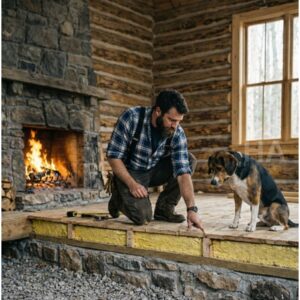
In the afternoons, he returned, smelling of earth and sweat. He wouldn’t rest. He would immediately go to our small, neglected backyard. He fixed the rotting fence, slat by slat. He swept the concrete until it shone. And then, he started to dig.
He turned the soil with a ferocity that frightened me. It was as if he were trying to bury his past, or perhaps dig his way out of it.
One evening, I found him on his knees, gently placing a seedling into the ground. His large, rough hands were surprisingly tender.
“What is that?” I asked, breaking the silence that usually hung between us.
He jumped slightly, then looked up. A small, tentative smile touched his lips—the first I had seen in a decade.
“It’s a seed, Tin,” he said, his voice raspy from disuse.
“I know that,” I laughed nervously. “But what kind?”
He patted the earth around the stem. “The kind that waits,” he said cryptically. “What I plant here… will feed good hearts.”
I didn’t understand him then. I thought he was just a broken man finding solace in the dirt. I didn’t know that he was planting the seeds of our salvation.
Years passed. The rhythm of our life settled. I worked at a warehouse, Mom took in sewing, and Uncle Elias worked his mysterious days and gardened his evenings. We were poor, scraping by month to month, but we were a unit.
Then, life decided to test us one more time.
The warehouse where I worked announced layoffs. I was young, expendable. I came home with a cardboard box and a severance check that wouldn’t last a month.
Two weeks later, Mom collapsed in the hallway.
The diagnosis was a blur of medical terms, but the financial reality was sharp and clear. She needed treatments. Expensive treatments. The little savings we had evaporated in the first week. The debts began to pile up like snowdrifts against the door—suffocating, cold, and relentless.
I sat at the kitchen table late one night, a stack of overdue bills illuminated by a single flickering bulb. The silence of the house was oppressive. Mom was asleep, her breathing raspy and difficult.
I had the deed to the house in front of me. It was the only asset we had left. Selling it would pay for the treatment, but it would leave us homeless.
A hand settled on my shoulder.
I jumped. Uncle Elias was standing there. I hadn’t heard him enter. He looked at the bills, then at the deed, and finally at my tear-streaked face.
“Don’t do it, Tin,” he said.
“I have no choice, Uncle,” I choked out, shame burning my cheeks. “She needs the medicine. I failed. I can’t support us.”
Elias pulled out a chair and sat opposite me. For the first time, he looked me directly in the eyes. The haunted look was gone, replaced by a steeliness I hadn’t seen before.
“When my brother died,” he said softly, “I fell apart. I became a monster. I hurt people. But when I came back, with nothing but the clothes on my back and a record that screamed ‘failure,’ your mother opened the door.”
He leaned forward. “She was the only one. The only one. Now, it is my turn to repay her.”
“Uncle, you don’t have any money,” I said gently. I didn’t want to hurt his pride, but facts were facts.
We use your personal data for interest-based advertising, as outlined in our
“Get some sleep,” he commanded, standing up. “Tomorrow morning, put on your boots. We are going for a ride.”
“Where?”
“Don’t ask questions. Just trust me.”
The next morning was gray and overcast. We climbed into Elias’s truck—a rusted, rattling beast he had bought for scraps three years prior. It smelled of gasoline and old soil.
We drove in silence, leaving the town behind. We climbed the winding roads into the mountains, the air growing thinner and crisper. The paved roads gave way to gravel, and the gravel gave way to dirt tracks that wound through dense forests of pine and oak.
“Uncle, where are we going?” I asked, gripping the dashboard as the truck bounced over a rut. “There’s nothing out here.”
“Patience,” he murmured.
After an hour, the trees suddenly broke. The road opened up into a valley that seemed to have been hidden from the rest of the world.
I gasped.
It was a vast expanse of land, acres upon acres of it. But it wasn’t wild. It was cultivated. Rows of fruit trees stretched out in perfect symmetry—apple, pear, cherry. Fields of vegetables were lush and green, bursting with life. In the center of it all stood a wooden house, simple but sturdy, with a wraparound porch surrounded by wildflowers.
Elias stopped the truck. The engine shuddered and died, leaving us in a profound silence, broken only by the chirping of birds and the wind in the trees.
“Whose is this, Uncle?” I whispered, awestruck. “Do you work here?”
Elias opened his door and stepped out. He took a deep breath of the clean mountain air.
“No, Tin,” he said, turning to look at me. “I don’t work for anyone here.”
He swept his hand across the horizon. “This… is ours. It’s for the family.”
I stepped out of the truck, my legs shaking. “I don’t understand.”
“When I got out,” Elias explained, walking toward the orchard, “I knew I couldn’t be a burden. I knew the world wouldn’t give me a chance. So, I made my own.”
He touched the bark of an apple tree. “I worked construction, day labor, sanitation—anything that paid cash. I lived on nothing. I saved every penny. I bought this land when it was just rocks and weeds because it was cheap and nobody wanted it.”
He looked at me, his eyes shimmering with unshed tears. “For ten years, Tin. Every day you saw me leave, I came here. I cleared the rocks with my hands. I built the house board by board. I planted every single one of these trees.”
“But… but why didn’t you tell us?” I stammered. “Why didn’t you use the money for yourself? You could have had a car, an apartment…”
“I don’t need those things,” he said firmly. “I learned in that cell that a man needs very little to survive. But he needs a lot to live. I needed redemption. I needed to know that if anything happened to Sarah—if anything happened to you—you wouldn’t be left with nothing.”
He reached into his pocket and pulled out a key. He pressed it into my hand.
“I learned that when you make a mistake, all you need is someone who still believes in your goodness,” he said. “This is my way of returning that trust.”
I stood there in the middle of that hidden paradise, holding a cold metal key, and I burst into tears. I cried for the fear I had carried, for the judgment I had silently harbored, and for the overwhelming realization that the man society had thrown away had built us a kingdom with his bare hands.
We moved Mom to the wooden house in the mountains. The air was cleaner there, the silence healing.
We use your personal data for interest-based advertising, as outlined in our
The transition was miraculous. Perhaps it was the absence of stress, or the mountain air, or the fruit that Uncle Elias picked fresh every morning, but Mom began to recover. The color returned to her cheeks. Her cough subsided.
We became farmers. I learned to prune the trees, to check the soil, to harvest the bounty. We took the produce to the markets in the city.
The customers noticed. “These fruits,” an old woman told me once, biting into a peach with juice running down her chin. “They have a different taste. Sweeter. Richer.”
I looked at Uncle Elias, who was weighing apples nearby. He smiled his rare, quiet smile.
“Because they were planted with gratitude,” he replied.
Life was good. For the first time in my memory, we were safe. But time, as always, is a thief.
Months after we moved, Uncle Elias began to slow down. The man who could clear a field in a day now had to stop to catch his breath after walking to the porch. He lost weight. His skin took on a gray pallor.
He tried to hide it, but I knew.
One afternoon, while he was napping, I found an old wooden box tucked in the corner of his room. It was polished smooth, crafted by hand.
Engraved on the lid were the words: “If you’re reading this, it means I’m now resting in peace.”
My heart hammered against my ribs. I opened it.
Inside was a stack of papers—the property deed, fully paid and transferred into my name. And on top of it, a letter written in his shaky, block handwriting.
“Tin,
I am not good with words. That is why I planted trees. Trees speak better than I do.
Thank you. Thank you and your mother for not rejecting me when everyone else did. You gave me a reason to wake up. You gave me a reason to stay sober.
I know I am sick. I have known for a while. Don’t be sad. I have done what I needed to do. I have secured your future.
One piece of advice from an old ex-con: Don’t be afraid of making mistakes. We all stumble. Be afraid of losing the goodness of your heart. Be afraid of becoming like those who turned their backs.
The land is yours now. Care for it, and it will care for you.
Love, Uncle Elias.”
I couldn’t finish reading it. The tears blurred the ink. I clenched the letter to my chest, feeling the weight of his sacrifice. He had worked himself into the ground to ensure we would have solid footing to stand on.
Two weeks later, he collapsed in the orchard.
We rushed him to the hospital, but the doctor just shook his head. Terminal cancer. It had spread everywhere. He had been in pain for months, maybe years, and never said a word.
In his last moments, the hospital room was quiet. The sterile beep of the monitor was the only sound. Mom sat by his side, holding his rough hand, weeping silently.
Elias opened his eyes. They were cloudy, but he found me.
“Sister…” he murmured, his voice barely a breath. “How sad… not to see Tin get married.”
“Don’t talk like that,” Mom sobbed.
He squeezed her hand weakly. “But I am leaving happy, Sarah. I know he understands now. I know… he knows what it means to live well.”
We use your personal data for interest-based advertising, as outlined in our
He looked at me one last time. “Take care of the trees, Tin.”
“I will, Uncle,” I promised, my voice breaking. “I swear it.”
He closed his eyes. A minute later, the monitor flattened into a long, singular tone.
My Uncle Elias died on a quiet Tuesday afternoon.
The wake was simple. There were no flowers bought from a shop; we covered his casket in wildflowers from his own meadow. There were no luxuries. The extended family—the aunts and uncles who had turned their backs—did not come. They sent a generic card, which I threw in the trash.
Only a few neighbors from the mountain and the market attended. But the room felt full. It was filled with love.
After the burial, I stood in the middle of the garden he had planted. The sun was setting, casting long, golden shadows across the rows of apple trees.
The wind brushed through the leaves, creating a sound like a thousand whispering voices. I closed my eyes and let the breeze hit my face.
“Don’t hate the world,” I swore I heard him say. “Live well, and life will be good to you.”
It has been a year since he passed.
The garden has grown into a large plantation. We have hired help now—people who, like Elias, needed a second chance. We supply the best restaurants in the city. We are prosperous.
But often, I walk the perimeter of the property, looking at the fence he built with his own hands.
If my mother had done like the others that day—if she had looked at his torn backpack and his criminal record and slammed the door—we would be destitute. I would have sold our home. Mom might not have survived. We would have never known the magic of this valley.
We would have missed the chance to know the greatest man I ever met.
People ask me sometimes how I became successful at such a young age. They ask who my mentor was, expecting me to name a business tycoon or a famous influencer.
I only have one answer.
“My hero,” I tell them, “was a convict. He was a man everyone rejected, a man the world called broken.”
I smile, thinking of the sweet taste of the apples he planted.
“But he loved us with a pure heart. And that made all the difference.”
Like and share this post if you find it interesting.