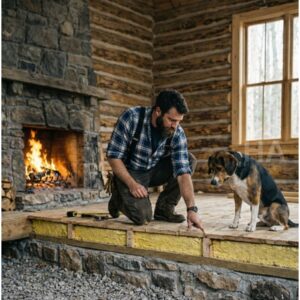
Marcus stood.
He didn’t talk about the shed.
He talked about himself.
About growing up in a house where doors were closed as punishment and silence was mistaken for obedience, about how no one intervened because it looked normal from the outside, and about how some lessons, once learned, take decades to unlearn, if they ever are.
Miles watched from the back of the room, hands clenched, as the adults argued over definitions.
In the end, the court ruled clearly. Roland lost custody rights. Miles was placed temporarily with a foster family who spoke softly and asked permission before entering rooms.
Renee visited sometimes, bringing snacks and asking about school, and Marcus came by once a month, never pushing, never promising things he couldn’t control.
Years passed.
Miles grew taller, steadier, less apologetic.
On his eighteenth birthday, he stood in a crowded room, nervous but smiling, and raised a glass.
“I used to think being quiet was the same as being good,” he said, his voice strong despite the tremor beneath it. “Now I know better. Being safe changes everything.”
Marcus nodded from across the room, eyes shining.
Cruelty doesn’t always look like anger. Sometimes it looks like laughter shared over a drink, like stories told for approval, like rules enforced without compassion. But it only survives as long as everyone agrees to look away, and this time, they didn’t.
And because of that, a boy who once counted breaths in the dark learned how it felt to stand in the light without fear.
But light, once found, doesn’t erase the memory of darkness. It only teaches you how to recognize it sooner.
Miles learned this slowly, in ways that didn’t announce themselves as growth. It showed up in small decisions at first—in how he flinched less when a door closed too hard, in how he stopped apologizing when someone else bumped into him, in how silence no longer felt like a requirement but a choice. Healing didn’t arrive as relief. It arrived as permission.
The foster home he moved into belonged to Clara and Denise Whitmore, a middle-aged couple whose house smelled faintly of bread and lemon cleaner, whose rules were written down not as threats but as expectations, and whose most radical habit was knocking before entering a room, even when the door was already open.
The first time Denise knocked, Miles panicked.
He’d been sitting on the bed, shoes still on, frozen in that half-ready posture children learn when they’re used to being summoned without warning. When the knock came—soft, deliberate—his heart spiked so fast it hurt.
“Yes?” he said, barely audible.
Denise opened the door slowly, her hands visible, her voice gentle. “Dinner’s almost ready. I just wanted to let you know.”
That was it. No command. No edge.
After she left, Miles sat there for a long time, staring at the door, trying to understand why his chest felt tight for a reason that wasn’t fear.
It would take months before he realized that what he was feeling was grief—for all the moments like that he’d never had.
At school, teachers were careful but not cautious, a difference that mattered. They corrected him when he was wrong without humiliation. They praised effort without turning it into spectacle. When he hesitated to ask for help, his math teacher, Mr. Alvarez, noticed and said one afternoon, “You know, needing help doesn’t mean you failed. It means you’re still trying.”
Miles wrote that sentence down and kept it folded in his backpack until the paper wore thin.
The neighborhood where he now lived was quieter, but not silent. Dogs barked. Kids rode bikes. On weekends, someone practiced the same piano song over and over, never quite getting it right. It felt alive in a way his old street never had, because life there hadn’t been something you tiptoed around.
Still, nights were the hardest.
The shed followed him into sleep.
Sometimes it appeared exactly as it had been—dark, narrow, smelling of oil. Other times it changed shape, becoming closets, basements, locked rooms with no doors at all. He’d wake up gasping, counting breaths automatically, his body remembering what his mind was trying to leave behind.
On those nights, Clara would sit outside his room, not entering unless he asked, reading quietly so he wouldn’t feel alone. Presence without pressure. Protection without control.
That balance saved him.
Marcus kept his distance, just as he’d promised. He never tried to become a hero in Miles’s story, never framed himself as a savior. When he visited, it was brief. A conversation. A check-in. Sometimes just sitting on the porch, watching traffic pass, saying nothing at all.
One afternoon, when Miles was thirteen, he finally asked the question that had been circling him for years.
“Why did you come?” he said, staring at the cracks in the concrete. “That night.”
Marcus didn’t answer immediately. He never rushed answers that mattered.
“Because someone should’ve come for me,” he said finally. “And they didn’t.”
Miles nodded, absorbing that without needing elaboration.
The truth was, Marcus wasn’t the only one changed by that night.
Renee left the bar six months later.
Not dramatically. No walkout. She finished her shifts, trained her replacement, and moved on. She took a job managing a community center café across town, a place where kids lingered after school and adults noticed when they didn’t.
Sometimes she caught herself listening too closely when parents joked about discipline, about “teaching lessons,” and every time she did, she remembered how close Miles had come to becoming another story no one wanted to unpack.
She learned to interrupt those jokes.
Roland Pierce didn’t learn anything.
That was the hardest truth for people who wanted the story to end cleanly. He blamed the court. He blamed outsiders. He blamed “overreach.” In private conversations, he reframed himself as a victim of modern softness, a man punished for refusing to be weak.
But the law didn’t care about his narrative.
He was required to attend counseling. Parenting classes. Anger management. He completed them mechanically, checked boxes, learned the language of remorse without ever touching its substance.
Miles never saw him again.
And that, too, was a gift.
Years passed the way they do when survival gives way to living—unevenly, quietly, filled with moments that don’t announce their importance until later. Miles discovered he liked building things. Not destructively, not aggressively, but methodically. Models at first. Then shelves. Then a birdhouse that took three attempts before it stopped leaning.
When he was fifteen, he joined a woodshop class.
The first time he smelled sawdust, something inside him settled.
His instructor, Ms. Patel, noticed how carefully he handled tools, how he double-checked measurements, how he respected the process rather than rushing toward completion.
“You work like someone who knows what happens when things aren’t done right,” she said once.
Miles didn’t respond, but he understood.
At eighteen, when he stood in that crowded room and spoke about safety, it wasn’t a triumph. It was a declaration. He wasn’t grateful for survival anymore. He expected it.
After that night, people came up to him with stories of their own. Not dramatic confessions, just fragments. A locked room. A joke that went too far. A punishment that felt like disappearance.
Miles listened.
He didn’t always know what to say.
But he stayed.
In college, he studied social work with a focus on child advocacy, though he never framed it as a calling. It felt more like maintenance—keeping systems from rusting into harm. He interned with family courts, with shelters, with after-school programs where kids learned how to speak without flinching.
One day, during a training session, an instructor asked, “What do you do when the harm doesn’t look extreme?”
Miles answered without hesitation. “You stop calling it small.”
The room went quiet.
Years later, he stood outside a school playground, watching a group of kids argue over rules to a game that didn’t matter. One boy shoved another. A teacher intervened quickly, firmly, calmly.
Miles felt the familiar tightening in his chest—but it passed.
Because this time, someone noticed.
He thought of the shed. Of laughter at a bar. Of how close cruelty had come to being filed away as humor.
He thought of all the times people said, It’s not that bad.
And he understood something fully, finally:
That cruelty depends less on the people who commit it than on the people who excuse it.
That protection is not dramatic—it’s consistent.
And that the moment someone stops laughing and starts asking questions, the story changes.
Miles walked away from the playground and into his future, carrying with him not the darkness of where he’d been locked away, but the clarity of what happens when someone decides that a child’s fear is not entertainment, not discipline, not acceptable under any name.
The shed still exists.
Someone probably stores rakes in it now.
But it no longer holds him.
And that is how cycles break—not with noise, not with revenge, but with presence, accountability, and the refusal to call harm by a softer name.