Lucas picked it up before Eleanor could protest, and the words on the top page cut through the warmth like ice: FINAL NOTICE – PROPERTY REPOSSESSION.
Eleanor closed her eyes, not in shame but in tired acceptance. “I didn’t mean for you to see that,” she said quietly.
Lucas set the folder down without judgment. “You don’t have to explain.”
But Eleanor did anyway, because sometimes survival required witnesses. She spoke of her house on Cedar Lane, of medical bills, of a loan that had promised relief and delivered ruin, of signatures that multiplied after she signed, of men with polite smiles who spoke of timelines and consequences while circling her life like vultures. She spoke of how Ash had dragged her out of a burning warehouse years earlier, how after that she trusted him more than people, and how when the foreclosure notice arrived, she packed what she could carry and left before the locks changed.
Outside, the wind howled louder, and Ash rose abruptly, body rigid, eyes fixed on the window. Lucas followed his gaze and saw it too, a flicker of headlights down the mountain road where none should be, briefly visible before vanishing behind trees. Ash let out a low sound, not a growl but a warning, and Eleanor’s hand tightened on the armrest.
“They found me,” she whispered.
Lucas felt the familiar click inside him, the moment when avoidance ended and decision began. He locked the door, stoked the fire, and said evenly, “You’re staying.”
Morning arrived brittle and bright, the storm leaving behind a silence that felt staged, and Lucas drove Eleanor into town for medicine, Ash riding alert in the back seat. At the pharmacy, Lucas noticed the logo on a bulletin board across the street—Northmark Holdings—and something about it lodged uncomfortably in his mind.
That discomfort sharpened when, at the general store, a man stepped into his path, smiling without warmth. “You’re not from around here,” the man said casually, eyes flicking to Eleanor through the window. “Looking for someone.”
Lucas met his gaze without blinking. “No.”
The man’s smile thinned. “Name’s Calvin Reed,” he offered, extending a hand that Lucas did not take. “Tell your friend she doesn’t need to run. Debts don’t disappear.”
The message landed exactly as intended.
Back at the cabin, Ash began pacing, nose tracing the perimeter with intent, and near the shed he stopped, pawing at snow until Lucas uncovered a small black device wired to a battery pack. Not surveillance. Something worse. Preparation.
The twist revealed itself slowly, brutally, as Lucas dug deeper, uncovering buried folders near the creek, contracts marked and categorized, addresses clustered near isolated properties, all bearing Northmark’s insignia. This was not foreclosure. This was harvesting.
Lucas contacted Mara Collins, a local investigative journalist whose byline had cost powerful people their comfort before, and when she saw the documents, her expression hardened. “This isn’t legal exploitation,” she said quietly. “It’s organized displacement. They clear people out, use properties temporarily, then burn the trail.”
That night, the power cut out.
Ash reacted before sound did, positioning himself between Eleanor and the door as headlights flared briefly outside, then vanished. Lucas found a second device near the back fence, this one rigged to ignite. A warning. Or a test.
The confrontation came the next evening, not violent but surgical, when Calvin returned with two men and a tone wrapped in civility. “We’re just ensuring compliance,” he said, as if lives were spreadsheets. Ash stood his ground, muscles taut, eyes unblinking, and when Calvin stepped forward, Lucas’s voice cut through the cold.
“Take one more step,” he said calmly, “and you won’t like how this ends.”
The standoff broke not with fists, but with exposure.
At the town hall meeting the next night, Mara released everything, contracts, timelines, recorded threats, patterns too clear to deny, and when Northmark’s representative attempted to dismiss it as coincidence, Ash suddenly rose, head snapping toward the exit, body rigid with unmistakable alarm. Lucas followed the instinct without hesitation, and together with local police, intercepted a planned arson at an abandoned warehouse tied directly to Northmark’s operations.
The arrests came fast after that.
Eleanor’s house was returned pending investigation. Northmark folded under federal scrutiny. Calvin disappeared from polite society and reappeared in court documents. Ash slept deeper than he had in years.
Lucas did not move back into isolation.
Some doors, once opened, change the architecture of a life.
The Lesson
This story is not about a storm, or a soldier, or even corruption, though all three matter. It is about the quiet moments when a human being must decide whether comfort is worth more than conscience, whether staying silent is safer than standing firm, and whether opening a door on the coldest night might cost you peace but give someone else their life back. Courage is rarely loud, and miracles are often built from ordinary choices made under extraordinary pressure. When the world dares you to look away, sometimes the bravest thing you can do is stay, listen, and refuse to let someone disappear.
When the news of the arrests spread, the mountain town woke to a different kind of silence—the kind that follows truth when it finally has nowhere left to hide. People who had lived side by side for years without truly seeing one another now exchanged longer looks, heavier nods, as if acknowledging an unspoken guilt. They had sensed something was wrong, many of them had, but sensing had been easier than acting. Compassion, they were learning too late, required more than discomfort—it required courage.
Eleanor Hale felt the shift immediately. The way people greeted her changed. No longer with pity, no longer with the polite distance reserved for the unfortunate, but with a quiet respect that surprised her. She had not survived because she was lucky. She had survived because she refused to disappear.
The day she returned to her house on Cedar Lane, the sky was pale and brittle, winter sunlight reflecting off thin layers of snow. The yard was overgrown, leaves frozen into the ground where no one had bothered to rake them. Ash stopped at the edge of the driveway, his body stiff, nose low, processing memory through scent the way only dogs can. Every instinct told him this place mattered. Every instinct told him to guard it.
Eleanor paused at the front door, her fingers hovering over the handle. For weeks she had imagined this moment, feared it, wondered whether stepping back inside would feel like defeat. Instead, when she finally turned the knob and the door creaked open, what she felt was grounding. The house didn’t accuse her. It simply waited.
Inside, the rooms were smaller than she remembered, but honest. Dust coated surfaces she once polished weekly. A crooked picture frame still hung in the hallway, untouched by time or theft. She sat down slowly in an old chair by the window, exhaling a breath she hadn’t realized she’d been holding for months.
Ash moved room to room, deliberate and alert, checking corners, pressing his body briefly against her leg every time he returned, reaffirming presence. Protection was not something he turned off.
Lucas stayed on the porch.
He leaned against the railing, hands in his pockets, eyes scanning the treeline out of habit more than necessity. He had walked into danger zones before with less hesitation than he felt now. This wasn’t fear. It was awareness. Some doors, once opened, led to responsibility whether you asked for it or not.
The investigation widened quickly. What had first appeared to be aggressive foreclosure tactics revealed itself as something colder and more systematic. Northmark Holdings had targeted isolation—elderly homeowners, people without families nearby, veterans living off-grid, individuals unlikely to fight back. The properties weren’t the end goal. They were tools.
Temporary storage. Laundering sites. Silent exchanges conducted far from scrutiny.
And when those properties were no longer useful, they were erased.
Mara Collins’ reporting ignited what officials could no longer suppress. Articles turned into federal interest. Federal interest turned into raids. Names once spoken politely in town halls were now printed in bold type under the word indictment. Calvin Reed vanished from public life entirely, resurfacing only in court documents and whispered conversations that ended abruptly when someone walked too close.
Eleanor was asked to speak at a community forum.
She almost refused.
Standing in front of strangers had never been her strength. Survival had taught her to keep her head down, her story contained. But Ash settled at her feet the moment she stood near the podium, solid and unmoving, and something steadied inside her.
She didn’t speak about storms or villains.
She spoke about silence.
She spoke about how suffering becomes invisible not because it lacks signs, but because people learn to look away. How dignity can become a cage when asking for help feels like surrender. How one open door can interrupt a chain of cruelty long enough for truth to catch up.
Lucas stood in the back of the room, unnoticed by most, listening.
He didn’t see a grandmother. He saw a survivor.
People thanked him afterward, awkwardly, as if unsure what to do with their gratitude. He accepted none of it. He had not acted to be seen. He had acted because something in him still recognized right from wrong, even after years of trying to forget the difference.
Ash became something of a legend.
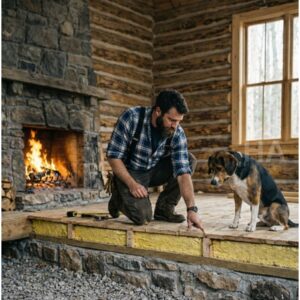
A photo of him sitting alert in the snow outside Lucas’ cabin ran on the front page of the local paper beneath the headline:
“Loyalty in the Storm: The Dog Who Wouldn’t Leave Her Side.”
Children asked to pet him. Adults asked his name. He accepted attention politely, briefly, but always returned to Eleanor’s side. Fame did not interest him. Purpose already filled that space.
Life did not return to what it had been.
It reorganized itself into something quieter, stronger.
Eleanor chose not to sell the house. Instead, she repaired it slowly, one room at a time, with help she did not ask for but learned to accept. Lucas helped with structural work, saying little, showing up consistently. Sometimes they worked in silence. Sometimes they shared coffee on the porch without speaking at all.
That was enough.
Ash aged more visibly once the danger passed. His steps slowed. His sleep deepened. Vigilance relaxed into rest. He had done his job.
One evening, as the sun dipped behind the mountains, Eleanor turned to Lucas and said, “You didn’t just save me.”
Lucas looked at her, puzzled.
“You reminded me,” she continued, “that being seen isn’t weakness.”
Lucas nodded slowly. “You reminded me,” he said, “that staying isolated isn’t strength.”
Neither smiled. The moment didn’t need it.
Some time later, Lucas moved down the mountain.
Not far. Just closer.
The Lesson
This story is not about a storm, or a soldier, or corruption—though all of those matter.
It is about the quiet moments where choice lives.
The moments where opening a door costs comfort but preserves humanity.
Where courage doesn’t announce itself, and compassion arrives without certainty.
The world does not collapse all at once.
It erodes—patiently—when we look away.
And sometimes, restoring faith doesn’t require heroics.
It requires staying.
Listening.
And refusing to let someone vanish into the cold.