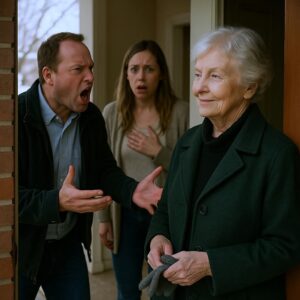
“Tell me,” Arthur said. He didn’t look frail anymore. He looked like a mountain. “Where are your parents?”
I told him everything. I didn’t embellish. I didn’t need to. The facts were damning enough. The refusal to visit. The fear of ‘catching something.’ The party photos. The balloons. The $1,000 invoice. The accusations of selfishness.
Arthur didn’t interrupt once. He stood there, leaning on his cane, his face an unreadable mask of stone.
When I finished, silence stretched between us.
Then he nodded, a slow, heavy movement. “They’ve been this way for a long time,” he said quietly. “You just didn’t want to see it, Elena. You have a good heart. You wanted them to be the parents you deserved.”
I looked down at the floor, tears stinging my eyes. “I wanted Mia to have grandparents.”
He put a heavy, calloused hand on my shoulder. “She has one. And you protected her from the ones who don’t deserve the title. That matters more.”
He pulled a small leather notebook from his pocket, scribbled something down, and tore the page out. “I need you to bring everyone to my house on Sunday. Your parents. Your sister. Everyone.”
“Grandpa, I’m not talking to them,” I said.
“You won’t have to,” he said darkly. “I’ll do the talking.”
That evening, Mia was discharged. As I buckled her into the car seat, ensuring the straps weren’t pressing on her bruised arm, my phone rang.
It was my mother.
“She’s out,” Mom said. Not asking. Stating. She must have seen the social media update I posted for my friends.
“Yes,” I said.
“Good. You can bring her to dinner tomorrow. We have leftovers from the party. And bring the check.”
“No,” I said.
There was a pause. “What do you mean, no?”
“I mean, we’re done for a while, Mom. We aren’t coming to dinner. I’m not sending money. We are taking a break.”
She laughed, a sharp, disbelieving sound. “Don’t be ridiculous. You’re holding a grudge because we had fun without you.”
“I’m holding a mirror,” I replied. “And I don’t think you like what you see.”
My father took the phone from her. I could hear the scuffle. “Listen to me,” he barked. “This family doesn’t revolve around your child. You need to learn your place.”
I closed my eyes, feeling the cool night air on my face. “That’s where you’re wrong, Dad. My life does revolve around her. And if you don’t fit in her orbit, you don’t fit in mine.”
I hung up.
Chapter 4: The Reckoning
Sunday arrived with a sky the color of bruised iron.
When we pulled into Grandpa Arthur’s driveway, my parents’ luxury SUV and my sister’s convertible were already there. My stomach tightened. I had left Mia with a trusted babysitter; I didn’t want her witnessing the crossfire.
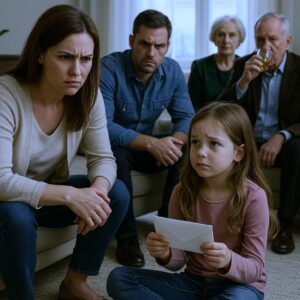
Inside, the living room was tense enough to snap a violin string. My sister, Sarah, sat stiffly on the floral couch, scrolling on her phone. My parents were standing by the fireplace, nursing drinks, avoiding eye contact with me.
Grandpa Arthur stood at the head of the room. He wasn’t sitting. He was standing straight, his cane resting against his leg.
“Sit down,” he commanded.
My father frowned. “Dad, what is this? We have reservations at five.”
“Sit. Down.”
The authority in his voice was absolute. My father sat.
“This isn’t a discussion,” Arthur began, his voice surprisingly strong. “It is a reckoning.”
He looked directly at my parents. “You refused to visit your granddaughter in the hospital while she was struggling to breathe.”
My mother opened her mouth to speak. “Dad, we were concerned about—”
He raised a hand, silencing her. “You claimed fear of illness. Yet, seventy-two hours later, you hosted a party for fifty people. You exposed yourselves to half the town.”
“That was different,” my mother insisted, her face flushing pink. “Leo’s birthday is a milestone!”
“And Mia’s survival isn’t?” Arthur shot back. The venom in his voice made my sister flinch.
“You sent her mother a bill while she was still in a hospital bed,” Arthur continued, pacing slowly. “You demanded money for a celebration you excluded her from. And you had the audacity to call that ‘fairness.’”
My father shifted uncomfortably. “We’re teaching her responsibility. She needs to contribute to the family.”
“You chose favorites,” Arthur said, cutting him off. “And for years, I watched it. I stayed quiet because I thought it would balance out. I thought you would grow up. But you didn’t. You stopped pretending.”
Silence filled the room. The grandfather clock ticked loudly in the corner.
Then Sarah scoffed. “This is being blown out of proportion. It’s just a party, Grandpa. Mia is fine now.”
Arthur turned to her slowly. “You learned this behavior from them,” he said sadly. “And you passed it on to your son. You take, and you expect others to give.”
She went quiet, looking away.
Then, Arthur did something none of us expected. He reached onto the side table and picked up a thick manila folder.
“I’ve made changes,” he said.
Everyone leaned forward. The air left the room.
“My will,” he continued. “And the Family Trust.”
My mother’s face went pale. The Trust was their retirement plan. It was the golden parachute they had been waiting for. “What changes?” she asked, her voice trembling.
“I’ve redistributed responsibility,” he said calmly. “And consequences.”
He looked at me. “You’ve been the one holding this family together financially for years, haven’t you, Elena? Covering the gaps. Fixing the rentals. Paying for the vacations quietly so your father could feel like the provider.”
I nodded, surprised he knew. I had never told him.
“That ends now,” Arthur said. “Not because you can’t, but because you shouldn’t.”
He turned back to my parents. “You will no longer receive financial support from the Trust. The quarterly stipends end today. And the inheritance? The house, the land, the investments?”
“Dad, you can’t,” my father said, standing up. “That’s our legacy!”
“It was your legacy,” Arthur corrected. “But you proved you don’t know how to care for family. So, I’m giving it to someone who does.”
“To who?” my mother whispered.
“To the child you ignored,” Grandpa said. “It is all going into a trust for Mia, with her mother as the executor.”
My mother stood up, shaking with rage. “She’s seven! She doesn’t need land! This is spite!”
“No,” Arthur replied, his voice dropping to a whisper that carried more weight than a scream. “This is justice. You valued a party over her life. Now, you can pay for your own parties.”
My sister began crying. “This isn’t fair! What about Leo?”
Arthur met her gaze. “Leo has parents who can throw him thousand-dollar parties. He’ll be fine. Maybe now you’ll teach him the value of earning something.”
He looked at the door. “Leave. All of you. Except my granddaughter.”
That night, they left. There were no shouts, no threats, just the shuffling of feet and the slamming of car doors.
Epilogue: The Quiet Peace
Months passed.
Slowly, deliberately, the noise faded. We stopped attending the obligatory Sunday dinners. I blocked my parents on social media. I stopped answering the guilt-filled text messages that swung wildly between “We forgive you” and “You are dead to us.”
And something unexpected happened.
Mia changed.
She stopped asking why Nana didn’t call. She stopped waiting by the window on holidays, anxious and hopeful. She stopped wondering what she had done wrong to make them distant. The anxiety that used to plague her—the stomach aches before family gatherings—vanished.
We built a smaller world. Just me, Mia, and Grandpa Arthur. We spent Sundays at his house, cooking simple meals and listening to his records. It was quiet. But this time, it was the peaceful kind of quiet.
One evening, closer to Christmas, we were baking cookies in my kitchen. Flour was everywhere. Mia was laughing, trying to shape dough into a star.
She stopped suddenly and looked up at me.
“Mommy?”
“Yeah, kiddo?”
“It’s okay if they don’t like me,” she said.
My heart clenched. I stopped mixing. “Why do you say that, Mia?”
She shrugged, her small shoulders rising and falling. “Because you do. And Grandpa does. And that’s enough.”
I had to step out of the room to breathe, tears stinging my eyes. She was right. It was enough.
A few weeks later, my sister showed up unannounced at my door. It was raining. She didn’t have an umbrella.
She looked smaller somehow. Tired. The veneer of the “golden child” had cracked without the financial cushion of the Trust.
“I didn’t realize,” she said quietly, standing on the porch.
“Realize what?” I asked, keeping the screen door closed.
“How much you did. How much Grandpa did. Mom and Dad… they are impossible. Without the money, they are just… mean.”
I didn’t argue. “They always were, Sarah. You just had the shield of being the favorite.”
She nodded, wiping rain from her cheek. “I just wanted you to know,” she said, tears forming. “I miss you guys.”
She hesitated. “Can I… can I see Mia?”
I looked at her. I remembered the party. I remembered the silence when my daughter was sick.
“Not today,” I said gently. “Maybe not for a long time. We’re happy, Sarah. We’re peaceful. I can’t risk letting the chaos back in.”
She looked devastated, but she nodded. She knew.
“Okay,” she whispered.
She turned and walked back to her car. I watched her go, then I locked the door, turned off the porch light, and went back inside to my daughter.
I wasn’t rich in the way my parents wanted to be. But as Mia handed me a misshapen cookie and told me it was the “best one ever,” I knew I was the wealthiest woman on earth.
Call to Action:
If you were in my position—receiving a bill for a party while your child was hospitalized—would you have cut ties immediately, or tried to make peace for the sake of the family? And do you think the Grandfather was right to change the will, or was that too harsh a punishment? Like and share this post if you believe family is about showing up, not just sharing DNA. Drop your thoughts in the comments below.