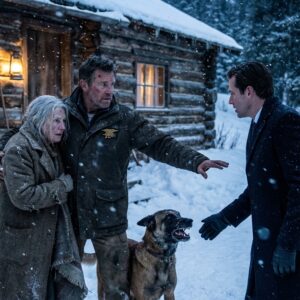
The dining room smelled of sage, roasted chestnuts, and expensive red wine. It was the smell of a perfect Christmas, the kind you see on the front of greeting cards or in glossy lifestyle magazines.
I stood by the kitchen island, wiping my hands on a stained apron. My feet were throbbing, swollen inside my house slippers. I had been awake since 4:00 AM. I had brined the turkey, peeled five pounds of potatoes, glazed the ham, and hand-whipped the heavy cream for the pumpkin pie. Every dish on that mahogany table was a labor of love—or perhaps, a labor of desperation.
Through the open archway, I could see them.
Mark, my husband of three years, sat at the head of the table. He was laughing at something his mother, Agnes, had just said. Agnes sat to his right, swirling her Cabernet in a crystal glass—a glass I had purchased two months ago with my quarterly bonus.
“It really is a lovely spread, Mark,” Agnes cooed, her voice dripping with that specific tone of artificial sweetness she reserved for her son. “You provide so well for this family.”
“I try, Mom,” Mark beamed, puffed up with pride. “Only the best for you.”
I swallowed the lump of resentment forming in my throat. You provide? I thought. You haven’t paid a utility bill in six months.
I untied my apron, smoothed down my simple grey dress, and walked into the dining room. I was exhausted, but I was hungry. I hadn’t eaten all day.
As I pulled out the chair opposite Agnes, the laughter stopped abruptly.
Agnes set her glass down with a sharp clink. She looked me up and down, her lip curling in distaste.
“Elena,” she said. It wasn’t a greeting; it was an accusation. “You aren’t planning on sitting down like that, are you?”
I paused, halfway into the chair. “Like what, Agnes?”
“Look at you,” she sniffed, waving a hand vaguely in my direction. “Your hair is a disaster. You have flour on your cheek. You smell like… grease. And sweat.”
I touched my face self-consciously. “I’ve been cooking for twelve hours, Agnes. I’m tired. I just want to eat.”
“Well, you’re ruining my appetite,” Agnes declared, turning her head away. “Mark, tell her. It’s disrespectful to sit at a holiday table looking like the help.”
I looked at Mark. My husband. The man who had promised to cherish me. He looked at his mother, then at me. The choice was made in an instant. It was always made in an instant.
“Mom is right, El,” Mark grumbled, reaching for the wine bottle to refill Agnes’s glass. “You look filthy. Go upstairs and shower. Change into something nice. Don’t embarrass me.”
“Embarrass you?” My voice was quiet, trembling with fatigue. “Mark, I made all of this. I paid for the turkey. I paid for the wine you’re drinking. I just want to sit down. My feet hurt.”
Agnes slammed her fork onto her porcelain plate. The sound echoed like a gunshot in the tense room.
“If she sits in that chair looking like a stray dog, I am not eating,” Agnes announced. “It is disgusting. I feel like I’m dining in a cafeteria.”
“You heard her,” Mark snapped, his eyes flashing with irritation. “Go change. Or eat in the kitchen. Just get out of sight until you look presentable.”
I looked at the feast. The steam rising from the mashed potatoes. The golden skin of the turkey. I looked at the walls of the dining room—walls I had paid to have repainted last summer. I looked at the chandelier I had selected and installed.
They treated me like a stray dog they allowed to sleep in the corner, never realizing I was the one paying for the roof over their heads.
I took a deep breath. The air in the room felt thin, suffocating.
“Fine,” I whispered. “I’ll go change.”
“Make it quick,” Mark muttered, already digging into the stuffing. “The food is getting cold.”
I turned around and walked toward the stairs. I didn’t run. I walked with a heavy, deliberate cadence. With every step, something inside me hardened. The sadness that had plagued me for years—the feeling that I wasn’t good enough, that I just needed to try harder to win their love—began to evaporate.
It was replaced by a cold, sharp clarity.
I reached the master bedroom and closed the door. I didn’t rush to the shower. I walked to the mirror and looked at myself. Yes, I looked tired. Yes, my hair was messy. But I didn’t look like a servant. I looked like a woman who was done.
I changed into a crisp, clean black dress. I brushed my hair back. I put on a layer of red lipstick.
When I walked back downstairs, I wasn’t coming back to beg for a seat at the table. I was coming back to flip it over.
I returned to the dining room ten minutes later. They were already eating. Mark had carved the turkey, piling the best white meat onto his mother’s plate.
I pulled out my chair again. The screech of the wooden legs against the hardwood floor made Agnes wince.
“Finally,” she muttered, her mouth full. “Though that lipstick is a bit much, don’t you think? You look like a streetwalker.”
I ignored her. I reached for the serving spoon for the potatoes.
“I said,” Agnes raised her voice, “I don’t want to look at your face with that paint on it. Go wipe it off.”
My hand froze on the spoon. “No.”
The word hung in the air. Simple. Absolute.
Mark dropped his knife. He turned to me, his face flushing red. “Excuse me? Did you just say no to my mother?”
“I did,” I said calmly, serving myself a large scoop of potatoes. “I cooked the dinner. I dressed for dinner. I am eating dinner. If Agnes doesn’t like my lipstick, she can close her eyes.”
“You ungrateful little bitch,” Agnes hissed. She looked at Mark. “Are you going to let her talk to me like that in your own house? After everything I did to save this place for you?”
That was the trigger. The lie that held their world together.
Mark stood up. He was a large man, soft around the middle but heavy. He threw his napkin onto the table.
“Get up,” he commanded.
“I’m eating, Mark.”
“I said get up!” Mark screamed. He rounded the table in three strides.
Before I could react, he grabbed my upper arm. His fingers dug into my flesh, bruising instantly. He yanked me out of the chair.
“You are going to apologize to my mother, and then you are going to the bathroom to scrub that whore makeup off your face!” he shouted, his spit flying onto my cheek.
“Let go of me,” I warned, my voice low.
“Are you deaf?” Mark roared.
And then, he shoved me.
It wasn’t a playful push. It was a violent, full-force shove intended to knock me to the ground. He put his weight behind it.
I stumbled backward. My heels caught on the edge of the Persian rug. I flailed, trying to catch my balance, but there was nothing to grab.
My head connected with the sharp corner of the oak doorframe.
CRACK.
The sound was sickeningly loud—the sound of bone meeting wood.
I hit the floor hard. For a second, the world went white. A high-pitched ringing filled my ears. Then, the pain arrived—a blinding, searing heat radiating from my temple.
I touched my forehead. My hand came away wet.
Blood. Thick, dark red blood. It dripped from my fingers, splashing onto the cream-colored carpet. It ran down my face, blinding my left eye.
“Oh god,” Agnes groaned.
I looked up, through a haze of pain, expecting to see horror on their faces. Expecting Mark to rush to me.
Agnes pointed a shaking finger at the floor. “She’s bleeding on the rug! Mark, the rug! It’s silk!”
Mark looked down at me, his face twisted not with concern, but with disgust.
“Look what you did,” he spat. “You clumsy idiot. Get up! Stop being dramatic.”
“I… I’m bleeding,” I stammered, shock making my voice thin.
“You’re making a mess!” Mark yelled. “Get a towel! Don’t just lie there bleeding like a stuck pig!”
He kicked my foot. “Get up!”
Something inside me snapped. It wasn’t a bone. It was the last tether of affection I held for this man. The illusion of marriage, of partnership, of hope—it all shattered instantly, replaced by a cold, mathematical rage.
They drew first blood.
I didn’t cry. I didn’t scream. I sat up slowly, the room spinning. I reached onto the table and grabbed a linen napkin—one I had embroidered myself—and pressed it hard against the gash on my head.
With my other hand, I reached into my pocket and pulled out my phone.
Mark sneered, crossing his arms. “What are you doing? Who are you gonna call? Your mommy? She’s dead, remember?”
I looked him straight in the eye. My left eye was shut from the blood, but my right eye was wide open.
“No,” I said. “I’m calling the police. And then, I’m calling my father.”
“911, what is your emergency?”
The operator’s voice was calm, a lifeline in the chaotic room.
“My name is Elena Vance,” I said, my voice steady despite the blood soaking the napkin. “I am at 4202 Maple Drive. I have been physically assaulted. I have a head wound that is bleeding profusely. There are two intruders in my home who are refusing to leave.”
Mark let out a bark of incredulous laughter. “Intruders? Are you insane?”
He stepped toward me, looming over where I sat on the floor. “Hang up the phone, Elena. Stop acting crazy.”
“Ma’am, are you safe?” the operator asked.
“For the moment,” I said. “Please send officers immediately. And an ambulance.”
I ended the call and tossed the phone onto the table. I used the table leg to pull myself up. I swayed, dizzy, but I locked my knees and stood my ground.
“You really did it now,” Mark shook his head, looking at his mother. “She called the cops. Can you believe this psycho?”
“She needs to be committed,” Agnes sniffed, dabbing at her mouth. “Calling the police on her own husband in his own house. Tell them to leave when they get here, Mark. Tell them she slipped.”
“This isn’t your house, Mark,” I said. The blood was dripping onto the collar of my dress now.
“Oh, shut up,” Mark rolled his eyes. “My mom saved this house when my business went under. Everyone knows that. It’s her house; she just lets us live here.”
“Is that what she told you?” I asked.
I walked over to the sideboard, where I kept the mail. Underneath a stack of Christmas cards, there was a blue file folder. I had brought it downstairs yesterday, anticipating a fight over finances, but I never expected this.
I threw the folder onto the dining table. It landed right on top of the roasted turkey, the corner digging into the meat.
“Open it,” I commanded.
“I’m not playing your games,” Mark said.
“Open it!” I screamed, the sound tearing from my throat, raw and primal.
Mark flinched. He reached out and flipped the folder open.
The first document was a Deed of Trust. The second was a bank transfer receipt dated six months ago.
“Read the name on the deed, Mark,” I hissed. “Read it out loud.”
Mark stared at the paper. His brow furrowed. “Elena… Vance.”
He looked up, confusion warring with anger. “What is this? Mom said she paid the arrears. She said she wired the $500,000 to the bank.”
“Your mother,” I said, pointing a blood-stained finger at Agnes, “hasn’t had $500,000 since the 90s. She is a gambling addict, Mark. She lost her condo three years ago. Why do you think she’s always staying here?”
Agnes went pale. She gripped her wine glass so hard her knuckles turned white.
“Don’t listen to her, Marky,” Agnes stammered, her voice rising in pitch. “She forged it. She’s a liar!”
“I paid the debt,” I said, stepping closer to Mark. “My inheritance from my grandmother. The money I was saving for our future children. I used it to pay off your gambling debts and your mortgage because I didn’t want you to be homeless. I bought this house. I own every brick, every beam, and every piece of food on this table.”
Mark looked at the bank receipt. It showed a transfer from my personal trust directly to the mortgage lender. There was no denying it.
He looked at his mother. Agnes shrank back in her chair, unable to meet his eyes.
“Mom?” Mark whispered. “You said… you swore you handled it.”
“I was going to pay her back!” Agnes cried defensively. “I just needed a lucky streak!”
“So,” I said, wiping blood from my eyebrow. “You are not the lord of the manor, Mark. You are a guest. And you just assaulted the homeowner.”
Blue and red lights flashed through the front window, painting the walls in chaotic bursts of color. A siren wailed, cutting off abruptly as the cruiser pulled into the driveway.
“The police are here,” I said.
Mark panicked. “Elena, wait. Baby, please. Don’t do this. It was an accident. We can explain. Just tell them you fell. If I get an arrest record, I lose my license.”
“You should have thought of that before you cracked my head open,” I said.
Someone pounded on the front door. “Police! Open up!”
Mark moved to answer it, perhaps to spin his story first, but I was faster. I stumbled to the door and threw it open.
The cold winter air hit my face. Two officers stood there, hands resting near their holsters. Behind them, pulling up onto the lawn because the driveway was blocked, was a matte black Ford F-150.
The officers looked at me—at the blood soaking my hair, the red stain on my dress, the swelling of my eye. Their demeanor shifted instantly from caution to action.
“Ma’am, are you okay?” one officer asked, stepping inside.
“He’s in the dining room,” I pointed.
But my eyes weren’t on the police. They were on the black truck. The driver’s door opened. A heavy cane hit the pavement, followed by a pair of polished combat boots.
General Thomas Vance (Ret.) stepped into the light. He wore a long wool coat, but underneath, I knew he was made of iron and scars. He looked at me, saw the blood, and his face—usually stoic—turned into a mask of terrifying, quiet wrath.
“Daddy,” I whispered.
The two police officers entered the dining room. They took one look at Mark, then at the blood trail leading to the doorframe, and the scene was clear.
“Sir, turn around and place your hands behind your back,” the lead officer commanded, reaching for his cuffs.
“Wait, officer, please!” Mark stammered, holding his hands up. “It’s a misunderstanding. My wife, she tripped. She’s clumsy. Ask my mother!”
“He pushed her!” I said from the doorway. “He shoved me into the doorframe because I wouldn’t apologize to his mother.”
“Turn around. Now!” The officer grabbed Mark’s wrist and spun him, clicking the handcuffs into place. Mark began to sob, a pathetic, high-pitched sound.
Then, the air in the room seemed to drop twenty degrees.
My father walked through the front door. He didn’t rush. He moved with the inevitable momentum of a tank. The thud-click, thud-click of his cane on the hardwood floor silenced the room.
He stopped in front of me. He didn’t speak. He gently took my chin in his gloved hand, tilting my head to inspect the wound. His eyes, steel-grey and cold, assessed the damage with military precision.
“Four stitches, maybe five,” he murmured. “Concussion likely.”