The Uniform
The first thing Karen Thompson did wasn’t call the cops.
The first thing she did was touch my wife.
It happened so fast I didn’t even register the motion as a decision. One moment I was standing on the porch in my slippers with a mug of coffee, watching Sophia adjust a sprinkler head near the edge of our lawn. The next moment Karen came flying across her immaculate grass like she’d spotted prey, her tiny white poodle yapping behind her on a leash.
“This is fraud!” Karen shrieked as she reached Sophia. “You’re impersonating a soldier!”
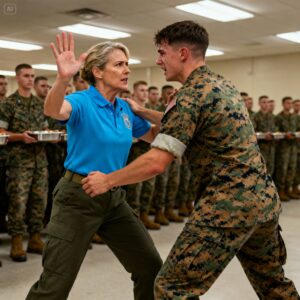
Sophia didn’t flinch. She wasn’t even facing Karen when the HOA president’s fingers raked the shoulder seam of Sophia’s faded utility jacket. The cloth tore in a thin strip with a sound like paper ripping, and something in the air changed immediately, like the temperature in the whole neighborhood dropped ten degrees.
Sophia turned slowly.
Her eyes landed on Karen with an icy focus that didn’t belong in suburban daylight. It wasn’t anger the way civilians show it. It was assessment. Distance. The kind of stare that made you feel like you had wandered into a room you weren’t qualified to enter.
Karen didn’t notice the shift. Or maybe she did and it made her louder.
“Everyone’s been saying it!” Karen screamed. “You’re sick. You’re unstable. You’re pretending to be something you’re not!”
Sophia’s voice was low. Even. “Touch me again, and you’ll regret it.”
That should have been the end of it.
But Karen lived for escalation the way some people lived for sunlight. Her entire identity was built around transforming small inconveniences into moral crises. She was the HOA president in our cul-de-sac, the self-appointed guardian of lawns, shutters, and the “character” of the community. She ran neighborhood life the way a prosecutor runs a courtroom—assuming guilt first, then hunting for evidence to justify her certainty.
My name is Michael. I’m forty-two, remote software engineer, predictable routine, predictable patience. If you’d asked me six months earlier what my biggest stressor was, I would’ve said deadlines and Wi-Fi issues.
But my wife wasn’t built for boring.
Sophia is forty-three. She’s athletic in a way that never looks like effort. She doesn’t waste words. She doesn’t waste motion. She returned home two months ago from what she called “an extended assignment overseas,” and the way she said it made it clear there were details I wasn’t allowed to ask.
We’d met years ago at a friend’s barbecue. She had been polite, slightly distant, and brutally funny in a dry way that made me feel seen without feeling handled. We married fast by some people’s standards. She never lied to me about who she was. She just didn’t tell me everything, and I’d learned the difference.
When she came back from her last assignment, she was quieter than usual. Not sad exactly. Just contained. Like she’d packed something away and locked it.
One morning she pulled an old set of fatigues from a box in the garage—a worn jacket and faded camo pants—because she wanted something comfortable while checking the sprinkler system. That was it. That was the entire crime.
Karen spotted her during her daily dog parade. She stopped dead, eyes narrowing—not at the clothes as fabric but at what the clothes represented. She didn’t say anything then. She just inhaled sharply, yanked her poodle away like Sophia was contagious, and marched off with a stiff chin.
That afternoon an HOA notice arrived in a thick envelope with gilded lettering and Karen’s elaborate cursive scrawled across the bottom like she’d signed a verdict. Citation: inappropriate attire causing discomfort and unease among residents. The phrase was vague on purpose. Karen loved vague. Vague let her fill in the details later with whatever story gave her the most control.
I read it twice, then laughed once in disbelief. Sophia looked over my shoulder and shrugged like it was weather.
“Let her waste her time,” she said.
“It’s not a real violation,” I insisted.
“Michael,” Sophia said gently, and that was the first sign she understood something I didn’t. “People like that don’t need rules. They need targets.”
She was right.
Within days we started finding unsigned notes in our mailbox accusing Sophia of faking military service. The language was sloppy, full of misspellings, but the intention was sharp: Fraud. Impersonation. Felony. Danger. Threat. Karen never wrote her own name on anything dirty. She was too careful for that.
I wanted to confront her. Sophia told me not to.
“We don’t react,” she said. “We watch. We collect. We evaluate.”
It was the way she said it—like the neighborhood was terrain—that made my stomach tighten.
She spent more time in her study. Phone calls that went silent when I entered the room. She wasn’t panicking. She was preparing.
At the quarterly HOA meeting in the rec center, Karen turned the whole thing into a trial. She stood at the podium and displayed blurry photos of Sophia in fatigues—taken from a distance, without permission—and pointed at the screen as if she’d uncovered a terrorist plot.
“This person,” Karen declared, “is blatantly flouting our norms and possibly faking military service. We cannot tolerate deception.”
People murmured. Some nodded. Some looked uncomfortable and said nothing, which helped Karen as much as agreement did.
The neighborhood shifted. Some people stopped waving. Some avoided eye contact. Karen’s narrative spread because it was easy. It required no thought, only suspicion. And suspicion, in a gated suburb, was a kind of hobby.
The day she put on the uniform again was not defiance. It was grief.
That morning was crisp, early fall air. Sophia stood on the porch in her fatigues, ringed by quiet. She didn’t say anything, but I recognized the posture. Not casual. Not performative. Ritual.
I didn’t ask. I just stood with my coffee and respected whatever private memorial she was holding.
Karen saw it and snapped. She came out like a banshee, sprinting across her lawn, shouting “fraud” and “felony” as if she’d been waiting her whole life for this moment.
And that’s when she grabbed Sophia.
The moment Karen tore the fabric, two patrol cars rolled in like they’d been summoned by her screaming.
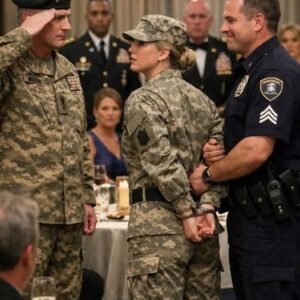
Lights pulsed without sirens. Two officers stepped out with that cautious posture cops use when they don’t know what they’re walking into. Hands hovering near belts. Faces controlled. Professional.
Karen spun toward them like she’d been awarded a stage. “Officers! Arrest her. She’s impersonating a soldier. She’s unstable. She attacked me!”
I started forward. “That’s not what—”
Karen’s voice drowned me out. “She’s been terrorizing the neighborhood! She’s wearing a uniform illegally!”
Sophia didn’t move. She stood with her arms relaxed at her sides, eyes steady, expression unreadable. It wasn’t indifference. It was restraint so complete it looked like calm.
Officer Hayes—burly, older, with the eyes of someone who’d seen enough to stop being easily impressed—approached Sophia. “Ma’am, can you tell me your name?”
“Sophia Reed.”
Hayes reached for cuffs, not yet committed but ready. Then his gaze locked on Sophia’s face and something flickered there. A micro-change. Recognition fighting with disbelief. He hesitated. His hand paused.
Officer Ruiz stepped to the side, scanning Sophia’s jacket, her posture, the way she held herself. His eyes caught something near the inside pocket—an edge of a card, partly concealed.
Ruiz didn’t grab it. He didn’t bark. He asked. “Ma’am, do you have identification?”
Sophia nodded once. She reached slowly, deliberately, and pulled out a card.
Ruiz’s eyebrows shot up. The card wasn’t a driver’s license. It was thicker. Official. Too official. Gold embossing. Ruiz’s mouth tightened as he read it. He looked at Hayes and his voice dropped.
“Hayes. You need to see this.”
Hayes leaned in, read, and his face changed in real time. Surprise, then something close to reverence. They stepped back in unison—not in fear, but in recognition. Their posture shifted from command to caution, from authority to deference.
Karen didn’t notice immediately. She kept talking, feeding her own momentum. “See? She’s got fake cards too—”
Hayes cut her off with a voice like steel. “Ma’am. Back up. Now.”
Karen froze. “Excuse me?”
Hayes didn’t look at her. His eyes stayed on Sophia. “Ma’am,” he said, and his tone was suddenly respectful, “is there anyone you need us to contact?”
Sophia’s expression didn’t change. “Yes. Call the number on the back. Tell them there’s been an incident.”
Ruiz swallowed, then nodded like he’d been given an order he understood.
Karen’s face twisted. “What is happening? Why are you—”
Hayes turned to Karen, and now he did look at her. His disappointment was palpable.
“Ma’am. She’s not impersonating anyone.”
Karen’s mouth opened. No sound came out.
Then Hayes spoke words that made my heart lurch.
“This is Lieutenant General Sophia Reed. She’s on classified duty. Her file is sealed.”
The block went silent. Even Karen’s poodle stopped yapping, as if it sensed the gravity.
I stared at Sophia like she’d turned into someone else right in front of me. I knew she was important. I knew she worked in places civilians didn’t. But general?
Sophia looked at Karen with that same flat, steady gaze. She wasn’t enjoying this. She wasn’t angry in a petty way. She was simply letting truth exist in the space Karen had filled with lies.
Karen’s face drained of color. Her lips trembled. “That’s… that’s impossible,” she whispered.
Hayes addressed Karen again. “You assaulted her. You tore her clothing. You made false reports. You created a public disturbance. You may have compromised operational security.”
Karen’s voice cracked. “I was protecting the neighborhood!”
Hayes’s eyes were cold. “No. You were harassing someone you didn’t understand.”
Neighbors whispered in stunned fragments. “General?” “Her?” “That’s Michael’s wife?” Someone across the street murmured, “I knew she wasn’t just… normal.”
I felt heat rise in my face—not pride, not exactly, but anger at the months of suspicion poured onto Sophia like acid, and anger at myself for not forcing this to end sooner. But Sophia touched my wrist once, light and grounding, like a reminder to stay steady.
A black SUV arrived within minutes, moving faster than anything should move in a residential neighborhood. Another followed. Then a third. Men in plain clothes stepped out, scanning, positioning, controlling the street without making it obvious. Their faces were neutral. Their eyes were not.
One approached Sophia and spoke quietly. Sophia answered in a voice I barely recognized—formal, clipped, used to command.
Karen watched this and seemed to shrink, her authority evaporating like mist. Then the man in plain clothes turned to Hayes. Hayes nodded once and stepped toward Karen.
“Ma’am, you’re going to sit on the curb.”
“You can’t—”
“Yes. I can.”
She sat. Her hands shook.
That evening, there was an emergency HOA meeting. The rec center was packed. People who normally skipped gatherings showed up like it was a trial they couldn’t miss.
Karen sat at the front, disheveled. Her hair wasn’t perfect. Her makeup wasn’t perfect. Her confidence looked like it had been drained through a crack.
Sophia entered with our attorney, Lisa Grant, a woman in a sharp suit with eyes that looked like they’d never lost an argument.
The room went silent. Sophia didn’t announce herself. She didn’t need to. She simply sat, and the space around her reorganized itself.
Karen tried to speak first. “This is—this is a misunderstanding,” she said, voice trembling. “I was acting out of civic responsibility—”
Lisa stood. “We’ll begin with facts.”
A projector flickered on. Footage from our doorbell camera: Karen sprinting across the lawn, grabbing Sophia, tearing the jacket, screaming about fraud.
Gasps rose. Someone muttered, “She attacked her.”
Karen’s face collapsed into horror.
Lisa clicked again. A folder of printed HOA notices, letters, and anonymous notes. Handwriting comparisons. Timelines. Witness statements from people who’d received Karen’s “civic responsibility” firsthand.
Then Sophia spoke, and her voice was quiet enough that the room had to lean in.
“I wasn’t alone,” Sophia said. “You targeted other veterans in this community. You questioned their service. You accused them of lying. You used HOA power to punish them when they didn’t fit your idea of ‘acceptable.’”
A murmur swept through the room. A man in the back stood up, voice shaking with fury.
“She did it to me,” he said. “She said my disability parking sign was ‘ugly’ and ‘not in keeping with neighborhood standards.’ She asked if I was ‘really disabled’ or ‘just milking it.’ I served in Iraq. I came home with a spine that doesn’t work right.”
Another man stood. “She told me my flag wasn’t regulation—not the flag itself, how I hung it. She fined me and told me ‘real vets respect standards.’ I was in Fallujah. I don’t need an HOA president to test me.”
A woman spoke next, voice flat. “She told my husband his service record was ‘probably exaggerated.’ He doesn’t talk about Afghanistan because his best friend died there. Karen joked about it at a block party.”
My stomach turned. Sophia’s posture didn’t change, but I felt her go still in a way I recognized. Not angry movement. Anger locked down.
Then a young mom, maybe early thirties, stood with a folded paper in her hand. “I’m not a vet. But my brother is. PTSD. Nightmares. He’d sit on my porch because it made him feel safer. Karen called him a ‘public safety risk’ and said she was going to petition to have him removed.”
Removed. Like he was a pest.
The mom’s voice broke. “I moved him out of here because I was scared. Not of him—of her.”
That was when Sophia stood. Not dramatically. Not with a speech cadence. Just up, steady, voice calm enough to force the room into attention.
“You did what you thought would keep him safe,” Sophia said to the young mom. “But the problem was never your brother. The problem was a system that rewarded Karen for being loud.”
She turned slightly toward the circle. “People like Karen thrive when decent people treat conflict like contamination. They think silence is permission.”
Nobody spoke. The room held itself still.
“I’m not asking you to be brave in combat,” Sophia said. “I’m asking you to be brave in conversation. When someone lies, say that’s a lie. When someone bullies, say that’s bullying. When someone tries to isolate a person, don’t help them by looking away.”
Karen tried to stand. “I was protecting—”
“No,” someone shouted. “You were bullying!”
Sophia didn’t raise her voice. She didn’t need to. “This isn’t about my uniform,” she said. “This is about abuse. Power used for control. And it ends now.”
Karen’s removal was unanimous.
Not close. Not contested. Unanimous, like the room finally exhaled after months—maybe years—of pretending her behavior was normal.
Lisa laid out the consequences with clean, legal precision. Civil damages. Harassment claims. Assault. False reporting. Potential federal implications because Karen’s obsession had escalated into photographing and publicly accusing someone whose work could not be publicly discussed.
The same neighbors who once looked away now looked directly at her like they were seeing her clearly for the first time.
Sophia didn’t gloat. She didn’t humiliate Karen the way Karen had tried to humiliate her. She simply stood and gave the room something it hadn’t expected.
“Some of you believed her,” Sophia said.
The statement wasn’t a question. It was fact. People shifted, ashamed.
“I understand why. It’s easy to believe the loudest voice. It’s easier than doing your own thinking. But there’s a difference between being misled and choosing cruelty.”
She let silence sit for a moment.
Then, softer: “I came home because I wanted quiet. I wanted my life with Michael. I didn’t come here to be anyone’s symbol. I came here to grow vegetables, fix sprinklers, and sleep through the night.”
A few people laughed nervously. Then someone—a woman who’d avoided us for weeks—stood up, eyes wet. “I’m sorry. I let Karen scare me into thinking… I don’t even know what I thought. I’m sorry.”
Others followed. Apologies came clumsy and sincere. Some brief. Some long. Some people didn’t speak at all but looked like they wanted to.
Karen tried to approach Sophia as the meeting ended. Sophia didn’t step back. She didn’t step forward.
“I didn’t know,” Karen whispered.
Sophia’s tone was flat. “That’s not an excuse. You didn’t need to know who I was to treat me like a human being.”
Karen flinched like she’d been slapped.
Sophia turned away without another word.
Outside, the air felt different, as if the neighborhood itself had changed pressure. I squeezed her hand. “Are you okay?”
Sophia’s fingers tightened slightly. “I’m fine,” she said. But her voice had that tone she used when she meant: I’m functional. Not necessarily fine.
At home, she went into her study and closed the door. Not hard. Just firm.
An hour later, she came out with her jacket folded neatly over one arm. The torn seam was visible. She set it on the table like a relic.
“She didn’t just tear cloth,” Sophia said quietly. “She crossed a line.”
“Lisa is going to destroy her,” I said.
Sophia’s mouth moved slightly. “Lisa will do her job. But I’m thinking beyond Karen.”
“Beyond?”