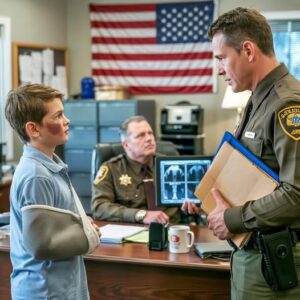
Child Protective Services arrived the next day.
They didn’t come in quietly—two agents, one woman with a thick notepad, the other a man with eyes that scanned everything in the house like a bomb disposal unit. My mother answered the door with her signature charm: hair done in a perfect chignon, sweater pressed without a single wrinkle, voice soft and sweet like diluted honey.
“Of course,” she smiled, the same smile she used to enchant my teachers and our neighbors. “There must be some misunderstanding.”
I stood behind her, silent. Silence was my mother tongue. It was how I survived.
Our house was sterile, almost surgical. No dust on the baseboards, no shoes cluttered in the entryway. It was a meticulously constructed stage, and my mother was the director, the screenwriter, and the lead actress. I was merely a prop—sometimes necessary, sometimes superfluous and needing to be violently put away.
When they asked to speak to me alone, her smile froze. For a split second, I saw the mask crack, revealing the cold abyss beneath. But she quickly plastered it back together with a light laugh.
“That’s not necessary,” she said quickly, her hand resting on my shoulder, fingers digging into my collarbone—a silent warning. “She’s just shy. She’s not used to strangers.”
“It’s protocol, ma’am,” the man said, his tone leaving no room for negotiation.
And for the first time, someone else was in control. Someone was immune to her performance.
My mother was forced to retreat. She walked into the kitchen, her footsteps heavier than usual. We sat in the living room, the carpet still stained from last week’s “clumsiness”—an accident involving spilled juice that left me limping for three days.
The female agent knelt to my eye level. She smelled of lavender laundry detergent, a scent that was pleasant but foreign.
“Your doctor sent over your scans,” she said gently but firmly. “We saw the injuries. We need you to tell us the truth.”
The truth.
That was a dangerous concept in this house. The truth wasn’t what happened; the truth was what my mother said happened.
I wanted to lie. I wanted to say I fell down the stairs, that I ran into a door, that I was a clumsy child with two left feet. I wanted to protect the life I understood, as twisted and small as it was. Because at least in this hell, I knew the rules. Out there was a world I knew nothing about.
But something cracked open inside me.
Maybe it was the way the nurse looked at me yesterday. Maybe it was the silence in the exam room when truth finally had weight.
Or maybe I was just tired. Tired of hiding bruises under long sleeves in the middle of summer. Tired of holding my breath when I heard the key turn in the lock every afternoon.
“My ribs,” I said, my voice raspy. “She hit me with the broom handle.”
The woman blinked, but didn’t flinch. She didn’t look horrified, which comforted me. Horror would make me feel like a monster. Her calm showed me I was just a victim.
“She says it’s discipline,” I added, the words tumbling out faster now. “That I don’t listen. That I need to be corrected.”
I didn’t cry. I didn’t shake. I just told the truth.
It poured out—years of stories I’d never dared to say aloud, not even to myself in the dark. The belt. The cigarette burn on my shoulder she claimed was from me “playing with fire.” The door lock at night to keep me from getting water. The way she smiled in public at church and screamed in private the moment the car door closed.
When I finished, they were silent.
Not out of doubt, but out of gravity. The weight of knowing, finally.
They took me that night.
I packed what little I owned—three shirts, two dog-eared books, and a sketchpad hidden under my bed. My mother stood on the porch, arms crossed, watching as I got into the state car.
She didn’t say a word. Her face wasn’t sad. There were no tears of a mother losing her child.
It was angry.
Not because I was hurt.
But because I told.
Her eyes bored into me through the car window like a curse, a promise that this wasn’t over. The car pulled away, and I realized I was shaking violently, not from cold, but from freedom.
My first foster home was awkward, strange, and full of new rules I didn’t understand.
I hated it at first. I didn’t know how to sleep without fear. I lay awake every night, listening for footsteps, waiting for the yelling, waiting for the pain. But it never came.
Here, when someone broke a plate, they just said, “Oops, be careful,” and swept it up. No screaming. No punishment. It terrified me more than the violence. This peace felt like a trap. I was constantly walking on eggshells, waiting for the other shoe to drop.
But the turning point came on a Tuesday evening.
I was helping Mrs. Miller, my foster mother, clear the table. My hands slipped, and a bowl of hot soup crashed to the floor, splashing onto my jeans.
I immediately curled into a ball, hands covering my head reflexively, bracing for the blow. I held my breath, eyes squeezed shut, preparing for the familiar pain.
But nothing happened.
“Oh my god, are you burned?”
I opened my eyes. Mrs. Miller was kneeling, not to check the floor, but to check my legs. Her face was full of worry, not anger.
“I… I’m sorry,” I stammered, tears springing from terror. “I’ll clean it. Please don’t hit me.”
Mrs. Miller froze. Her eyes filled with tears. She gently pulled my hands away from my head, and for the first time, someone hugged me without making me flinch.
“We don’t hit here,” she whispered into my hair. “It’s just soup. It’s only soup.”
I cried in the bathroom for twenty minutes afterward. I cried not out of sadness, but from the painful relief of realizing the world could be gentle.
I started therapy. I wrote everything. My story became pages and pages of truth, of pain, of survival.
The nurse from the clinic, the one who saved my life with her attention, visited once. She brought me a teal scarf. She said she thought about me every day since.
“You don’t know it yet,” she whispered, smoothing my hair, “but you’re going to be okay. You are stronger than you think.”
And for the first time, I started to believe her.
But the past doesn’t let go easily. The case went to court six months later. My mother had hired a shark of a lawyer, a man with a smile as sharp as hers. They weren’t going to plead guilty.
They were going to fight. And their weapon was to paint me as a pathological liar.
The night before the trial, I received an anonymous letter at my foster home. Inside was just a single line cut from a newspaper: “The ungrateful child loses everything.”
The trial took place in a cold room humming with fluorescent lights.
By then, I had learned how to speak without whispering. How to look people in the eye. How to read through my own medical records without breaking down.
The prosecutor was calm, methodical. She showed the X-rays, dated scans from the last five years—four fractured ribs, a broken wrist, two healing fingers, and a partially healed jaw.
It was a geography of pain mapped across my body.
My mother’s defense attorney stood up. He tried to paint my mother as “overwhelmed” and “strict,” not violent. They used pictures of our living room, our school photos where I smiled stiffly, her clean record.
“Your Honor,” he said smoothly. “My client is a dedicated single mother. This child has a history of fantasy and self-inflicted injuries due to clumsiness. Are we going to ruin a woman’s life on the word of a rebellious teenager?”
My mother sat there, dabbing her eyes with a lace handkerchief. She looked small, frail, and pitiable. A master actress. For a moment, I felt sick. Would they believe her? She always made people believe her.
But truth has weight.
Especially when it’s written in bone.
I testified. Fifteen minutes on the stand. It was the longest fifteen minutes of my life. I wasn’t perfect—I stuttered, I paused, I shook—but I didn’t waver. I looked my mother in the eye for the first time in six months.
I told the jury about the punishments. The rules. The silences. The way she made me kneel on uncooked rice for hours if I got a B in school.
“She said if I ever told anyone,” I said quietly, my voice carrying through the silent courtroom, “they’d think I was making it up. She said nobody loves a broken child.”
The courtroom was silent. The judge listened carefully, not interrupting once.
But the final blow didn’t come from me.
My therapist testified next. Then the nurse. Then the doctor who took the X-rays.
The doctor pointed to the scan on the large screen. “This is not a fall injury,” he stated, his voice steel. “The angle of the fracture on the fourth and fifth ribs indicates direct, forceful, deliberate impact from a cylindrical blunt object. These are markings of repeated abuse, not accidents.”
One after another, they spoke for the child I had been. They were the protectors I never had.
In the end, the jury took only two hours.
When the clerk read the verdict, my mother stood up. She was convicted of felony child abuse and unlawful imprisonment. She was sentenced to nine years in prison with no parole.
She cried—not because of what she did, but because she lost control. For the first time, she was the one caged, and I was the one free.
After the verdict, the nurse found me outside the courtroom.
“I saw you,” she said, her eyes red. “That first day. I knew something wasn’t right the moment I saw you flinch when your mother raised her hand to smooth your hair.”
“You saved me,” I told her.
She shook her head, smiling sadly. “No. You saved yourself. I just paid attention.”
I was placed with a new foster family permanently—quiet people, kind, patient. They gave me space but also structure. At night, I could leave my bedroom door open. I didn’t have to hide bruises under sleeves anymore because there were no new bruises.
I enrolled in school again. I caught up slowly. I made one friend who liked the same books I did. She saw the faint scars on my arms, but she didn’t ask. She just held my hand.
I chose when to tell my story.
Now, I write letters to kids in shelters. I visit clinics as a volunteer. Sometimes I sit in waiting rooms and just watch, the way the nurse once watched me. Looking for that same deadly silence behind a child’s eyes.
Because I know what it feels like to be invisible.
And I know how much it means when someone finally sees you.