They Called It a Bicycle Accident
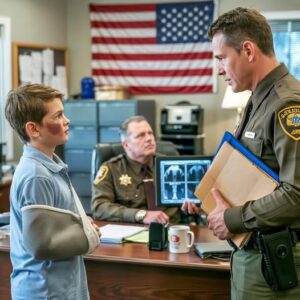
The pain shot through my wrist the moment I wrapped my fingers around the clinic’s door handle.
It wasn’t a sharp pain anymore. That had come and gone the night before. This was deeper—dull, heavy, like something inside me had been damaged in a way that didn’t want to heal quietly.
Behind me, James cleared his throat.
It was a small sound. Ordinary. Polite, even.
But my body reacted before my mind did. My shoulders tightened. My grip weakened. I nearly dropped my intake papers.
“Remember what we discussed,” my mother whispered quickly, leaning close enough that her perfume—lavender and anxiety—filled my lungs. Her eyes darted toward the reception desk, then back to James. “It was a bicycle accident.”
I nodded.
I always nodded.
I was twenty-two years old and living at home again. That was my first mistake.
The second was believing that confronting James would change anything.
The waiting room of Riverdale Physical Therapy Center was quiet in that careful, curated way. Soft instrumental music played overhead. Framed photos of smiling patients lined the walls—people mid-recovery, frozen in moments of optimism.
I sat down slowly, cradling my wrist against my chest.
James took the seat beside me.
Too close.
He crossed his legs casually, one ankle resting over his knee, as if we were just another normal family supporting one another through a minor inconvenience.
My mother, Sophia, sat across from us, twisting her wedding ring again and again until her knuckles turned pale.
No one spoke.
They didn’t need to.
Last night was still hanging in the air between us.
It had started with a question.
A stupid one, I’d realize later.
“Where’s the rest of the money?” I’d asked.
James had been sitting at the kitchen table, laptop open, phone face down beside his coffee. I hadn’t meant to sound accusatory. I just wanted clarity. Closure.
I’d checked my college account that afternoon. The one my late father had started for me when I was six. The one my mother promised was “safe.”
Most of it was gone.
James had looked up slowly.
“What money?” he asked.
“The college fund,” I said. “There was supposed to be enough for next semester. And now—”
His chair scraped back violently.
“You ungrateful little snitch,” he snarled, grabbing my wrist before I could react. His fingers locked around it, tight and precise, like he’d done this before. “Your mother and I can spend our money however we want.”
I tried to pull away.
That was when he twisted.
There was a sound—soft, wet, unmistakable.
Something inside me snapped.
I screamed.
My mother rushed in from the living room, eyes wide, breath shallow.
James let go immediately.
“Oh my God,” he said, stepping back, his voice already shifting. “Sophia, she tripped. She fell into me.”
I cradled my wrist, shaking, tears blinding me.
My mother looked at James.
Then she looked at me.
And in that moment, she made her choice.
“Family problems stay private,” she said softly.
That night, she wrapped my wrist herself. Drove me past the ER. Told me we’d go somewhere quieter in the morning.
Somewhere without questions.
Now, sitting in the clinic, I stared at the door to the treatment area like it might swallow me whole.
“Sophia Rivers?” the receptionist called.
My mother stood quickly. “That’s us.”
James smiled. “Ladies first.”
I walked toward the exam room with my heart pounding, repeating the words in my head like a prayer.
Bicycle accident. Bicycle accident. Bicycle accident.
Dr. Diana Cain was nothing like I expected.
She wasn’t old. She wasn’t cold. She didn’t wear the distracted expression I’d seen on ER doctors rushing between rooms.
She looked up from my intake form slowly.
Sharp green eyes. Calm posture. Observant in a way that made my skin prickle.
“Interesting,” she said.
James leaned forward instantly. “Is something wrong?”
She didn’t answer him.
Instead, she turned the X-rays toward the light panel and studied them in silence.
“You must have fallen at a very specific angle,” she said at last, her voice neutral. “To create this particular fracture pattern.”
My stomach dropped.
James laughed lightly. “Our Sophia has always been clumsy. Remember last year with the stairs, honey?”
I remembered.
The stairs. The car door. The cabinet corner.
Each incident followed by the same conversation.
You’re too sensitive.
He didn’t mean it.
Family stays together.
Dr. Cain nodded slowly, as if considering his words.
Then she turned to my mother.
“I’ll need to examine Sophia alone,” she said. “Standard procedure.”
“That’s not necessary,” my mother started quickly. “We’re very close—”
“Actually,” Dr. Cain interrupted gently but firmly, “it is. Patient privacy.”
James’s smile tightened.
For a moment, I thought he’d argue.
Then he shrugged. “Of course. We’ll be right outside.”
The door closed behind them with a soft click.
The room felt smaller instantly.
Dr. Cain turned the lock.
She didn’t sit down right away.
Instead, she leaned against the counter, arms crossed, studying me carefully.
“Let me guess,” she said. “This isn’t the first ‘accident.’”
My heart raced.
I stared at my lap. “I fell off my bike.”
She didn’t sigh. Didn’t push.
She picked up her tablet and pulled up another image.
“This is from six months ago,” she said. “Your ER visit for a shoulder injury.”
I looked up sharply. “How—?”
“Shared medical systems,” she replied. “See these faint lines here?” She pointed to subtle markings on the bone. “They’re consistent with a very specific type of trauma.”
My throat tightened.
“One I saw frequently in my previous job.”
I swallowed. “Previous job?”
She met my eyes directly.
“Before opening this clinic,” she said quietly, “I spent twelve years as a forensic specialist with the FBI. I focused primarily on domestic violence cases.”
The room felt like it was tilting.
She set the tablet down carefully.
“Sophia,” she said, her voice calm but unyielding, “bicycle accidents don’t leave these patterns.”
She paused.
“But forceful wrist manipulation does.”
Tears blurred my vision.
“You don’t understand,” I whispered.
She nodded once. “You’re afraid it’ll get worse if you say anything.”
A knock at the door.
James’s voice floated in. “Everything okay? Sophia tends to exaggerate her pain.”
Dr. Cain’s smile turned glacial.
“Oh,” she said evenly. “Everything is very clear now.”
The Truth Lives in the Details
Dr. Cain didn’t raise her voice.
She didn’t threaten. She didn’t dramatize what she knew.
That, somehow, made it worse—for James.
And safer for me.
She picked up my wrist gently, supporting it instead of testing it. Her touch was clinical, practiced, but careful in a way that told me she understood pain beyond charts and textbooks.
“Does it hurt more when I rotate like this?” she asked.
I nodded. “Yes.”
“And when I press here?”
“Yes.”
She released my wrist and sat down across from me.
“Sophia,” she said, folding her hands, “people think abuse always looks chaotic. Loud. Obvious. But the most common cases I worked on were quiet. Structured. Controlled.”
My eyes dropped to the floor.
“Accidents,” I whispered.
She nodded. “Accidents. Always with a witness who benefits from the story.”
I felt something inside me loosen—not relief, exactly, but recognition.
For the first time, someone was saying out loud what my body had known for years.
Outside the door, James shifted his weight.
I could hear it. The impatient tap of his shoe. The subtle sighs meant to remind us he was waiting.
Dr. Cain stood and walked to the door, opening it just enough to address him.
“We need more time,” she said calmly.
James smiled. “Of course. Take all the time you need. We just worry about her. She gets confused when she’s stressed.”
Dr. Cain held his gaze.
“Stress doesn’t confuse bone patterns,” she replied.
She closed the door again.
Locked it.
Back at the counter, she began typing.
“What are you doing?” I asked quietly.
“Documenting,” she said. “Everything.”
My heart raced. “I didn’t say—”
“You don’t have to,” she replied gently. “Medical documentation doesn’t require a confession. It requires consistency.”
She turned the screen toward me.
Dates. Injuries. Locations.
A timeline I’d never seen laid out so clearly.
“Your wrist,” she said. “Your shoulder. The bruising pattern noted during your ER visit last year. Always on the same side. Always explained away.”
Tears slipped down my cheeks before I could stop them.
“I tried to leave once,” I said. “After the stairs.”
She didn’t interrupt.
“My mom said he was under stress. That he needed support. That I shouldn’t provoke him.”
Dr. Cain nodded slowly.
“Abusers rarely act alone,” she said. “They rely on silence. And on someone else to help maintain it.”
I flinched—not at her words, but at how accurate they were.
Another knock.
This one sharper.
James’s voice carried through the door. “Is there a problem in there?”
Dr. Cain exhaled once, steady.
“Yes,” she said loudly enough for him to hear. “There is.”
She turned back to me.
“I need to ask you something important,” she said. “And I need you to answer honestly.”
I braced myself.
“Are you safe at home?”
My mouth opened.
No sound came out.
My chest felt tight, like the air had thickened.
“I don’t know,” I finally said.
That was enough.
Dr. Cain stepped into the hallway.
James straightened instantly.
“Sir,” she said, her tone professional and unyielding, “based on my examination and Sophia’s medical history, I have reason to believe this injury was not accidental.”
My mother gasped. “What are you saying?”
“I’m saying,” Dr. Cain continued, “that I am a mandated reporter. And I am filing a report today.”
James’s smile vanished.
“That’s outrageous,” he snapped. “You’re overstepping.”
She didn’t react.
“I’ve already contacted the appropriate authorities,” she said. “And I’ve arranged for Sophia to speak with a social services advocate—alone.”
My mother looked at me, panic flooding her face.
“Sophia,” she whispered, “please. You know how this will look.”
I stood slowly, my wrist aching but steady.
“I know how it already looks,” I said.
James took a step toward me.
Two security officers appeared at the end of the hallway.
Dr. Cain hadn’t been idle.
They separated us quietly.
Professionally.
No shouting. No spectacle.
Just consequences finally catching up to behavior that had relied on invisibility.
As I was escorted to a private room, my mother reached for me.
“I was trying to protect you,” she said, tears spilling.
I looked at her—really looked at her—for the first time in years.
“You were protecting him,” I replied softly.
Later, sitting alone with an advocate whose voice was warm and steady, I felt something unfamiliar settle over me.
Not fear.
Not relief.
Space.
For the first time, the story wasn’t being written for me.
I wasn’t rehearsing lines.
I wasn’t shrinking myself to survive.
Dr. Cain stopped by once more before the end of her shift.
“You did the hardest part,” she said.
I shook my head. “You did.”
She smiled faintly. “I recognized the pattern. You broke it.”
Outside, dusk fell over the parking lot.
James was gone.
So was the story of the bicycle accident.
And for the first time in a very long time, the truth didn’t feel dangerous.
It felt solid.
Leaving Isn’t Loud—It’s Precise
I didn’t go back home that night.
That detail matters more than people think.
Leaving abuse is rarely dramatic. There’s no packed suitcase by the door, no cinematic final argument. It’s quieter than that. More deliberate. Like stepping carefully onto ground you’re not sure will hold you.
The advocate drove me to a short-term housing facility just outside the city. The building was plain. Beige walls. Neutral lighting. Nothing about it suggested rescue or refuge.
But the door locked behind me.
And for the first time in years, it locked with me inside, not against me.
That night, sleep came in fragments.
Every sound felt unfamiliar. Not threatening—just new. A heater clicking on. Someone walking in the hallway. A distant siren.
I kept waiting for the moment I’d realize I’d made a mistake.
It didn’t come.
Instead, I felt something else: exhaustion so deep it bordered on relief.
The next morning, my wrist ached, but the pain felt different now. Less alarming. Like something that could actually heal.
I sat at the small desk in my room and stared at my phone.
Messages from my mother filled the screen.
Please call me.
You don’t understand how serious this is.
James is devastated.
We can fix this as a family.
I turned the phone face down.
Not out of anger.
Out of clarity.
At noon, Dr. Cain called to check in.
“Any questions so far?” she asked.
“So many,” I admitted. “But mostly… what happens next?”
“Next,” she said calmly, “is slow. That’s important. People expect justice to move fast once truth shows up. It doesn’t. It moves carefully.”
I nodded, even though she couldn’t see me.
“And you?” I asked. “Why did you notice?”
She paused.
“Because patterns don’t lie,” she said. “And because once you’ve seen them enough times, you can’t unsee them.”
Two days later, I returned to the clinic for my follow-up.
Alone.
That felt like a victory.
Dr. Cain removed my temporary brace gently and checked my range of motion.
“You’ll recover fully,” she said. “Physically.”
I smiled faintly. “And the rest?”
She met my eyes. “That takes longer. But you’re already doing the work.”
Outside the clinic, I sat on a bench and let the sun warm my face.
People passed by, busy with their lives. Laughing. Arguing. Living inside stories I would never know.
For the first time, I wondered what my story could look like if it belonged to me.
James didn’t contact me.
Not directly.
Instead, the messages came through my mother.
He was angry. Confused. Hurt.
He didn’t understand how this had “gotten out of hand.”
I understood exactly how it had.
A week later, I met with a counselor assigned through the advocacy program.
Her office was small and unremarkable, which made it easier to talk.
“Do you feel guilty?” she asked.
“Yes,” I said immediately.
“For what?”
“For leaving,” I said. “For telling. For not protecting my mother.”
She nodded. “That’s common. But let me ask you something.”
She waited until I looked at her.
“Who was protecting you?”
I opened my mouth.
Closed it.
The silence stretched—not uncomfortable, just honest.
“I don’t know,” I said finally.
She smiled gently. “Now you are.”
As days turned into weeks, the fog began to lift.
Small things changed first.
I stopped flinching when doors closed loudly.
I slept through the night.
I laughed once—out loud—at something stupid on TV and surprised myself.
Healing didn’t feel heroic.
It felt ordinary.
And that made it powerful.
One afternoon, I received an email from Dr. Cain.
It was brief.
Just checking in. Still proud of you.
I stared at the screen longer than necessary.
Pride was a word I hadn’t associated with myself in a long time.
I didn’t know what would happen with James.
Or with my mother.
Or with the life I’d left behind.
But I knew this:
The story had changed.
Not because someone rescued me.
But because someone recognized the truth—and trusted me to stand in it.
The Story I No Longer Had to Protect
Healing didn’t arrive all at once.
It came in small, almost unnoticeable moments.
The first time I reached for a glass without bracing myself for pain.
The first morning I woke up without my heart racing.
The first conversation where I didn’t rehearse my words in advance.
Each moment felt ordinary.
And that was the miracle.
I moved into a small apartment on the other side of town a month later.
It wasn’t much—one bedroom, thin walls, mismatched cabinets—but it was mine. No footsteps to anticipate. No moods to manage. No stories to memorize.
The first night, I sat on the floor and ate dinner straight from the container, listening to the hum of the refrigerator.
Silence didn’t scare me anymore.
It felt earned.
My wrist healed steadily.
Physical therapy was slow, repetitive, sometimes frustrating—but honest.
Every stretch had a purpose. Every movement had a boundary.
Dr. Cain checked in periodically, never intrusive, never distant.
“Your strength is coming back,” she said one afternoon. “Not just in your wrist.”
I smiled. “It feels different this time.”
“That’s because it’s yours,” she replied.
My mother called less often.
When she did, the conversations stayed shallow. Weather. Work. Neutral territory.
She never asked me to come home again.
I never offered.
Some relationships don’t end with explosions.
They fade when the truth no longer fits inside them.
Months passed.
I found a job. Took classes online. Rebuilt things quietly.
No announcements. No declarations.
Just choices that didn’t require permission.
One evening, while organizing old paperwork, I found a photo from years ago—me at sixteen, smiling too hard, standing between my mother and James.
I studied it for a long time.
Then I folded it carefully and put it away.
Not destroyed.
Just no longer displayed.
I ran into Dr. Cain once at a grocery store.
She was reaching for apples. I was debating cereal.
She smiled when she saw me.
“You look lighter,” she said.
I laughed softly. “I am.”
She hesitated, then added, “You know, people often think I saved you.”
I shook my head. “You recognized the truth. I chose it.”
She nodded, satisfied.
Looking back now, I understand something I didn’t then:
Abuse survives on repetition.
On stories told so often they start to sound like facts.
It was an accident.
You’re overreacting.
This is just how families are.
Breaking that cycle doesn’t require shouting.
It requires one person to stop repeating the lie.
I don’t know what happened to James after that.
I stopped tracking the outcome.
Closure isn’t always knowing how someone else’s story ends.
Sometimes it’s deciding you don’t need to watch anymore.
Today, when I grip a door handle, I don’t brace myself.
When someone asks me what happened to my wrist, I don’t invent explanations.
I say, “I was hurt. I got help. I healed.”
That’s enough.
They once called it a bicycle accident.
They needed it to be small. Accidental. Forgettable.
But the truth was never fragile.
It was just waiting for someone trained enough—and brave enough—to see it.
And for someone else to finally believe she deserved more.
THE END