The cold mountain air cut through the clearing like a blade. Eight hunters stood in a semicircle, their expensive camouflage gear pristine, their rifles gleaming in the November sun. In the center, a man knelt on the ground, trembling hands pressed against the dirt.
His clothes were torn, his beard wild, and his eyes were hollow. He looked like he hadn’t eaten a proper meal in weeks. Lieutenant Colonel Garrett Mitchell stood over him, arms crossed, a smile playing on his lips.
«So this is the great Marine sniper instructor? This is Iceman?» Garrett turned to his group, his voice dripping with contempt. «Look at him! Six years on the streets and he can barely hold his hands steady.»
Garrett laughed harshly. «And he wants us to believe he can still shoot?» The homeless man said nothing. He simply stared at the rifle lying in the dirt five feet away, a Remington 700 that might as well have belonged to a lifetime ago.
Garrett leaned down, his voice a whisper meant to carry. «Five shots. Eight hundred meters. You miss even once, you sign over that cabin and disappear.»
He sneered closer. «Because frankly, I don’t think you can even remember which end of the rifle the bullet comes out of.» The homeless man looked up. For just a moment, something flickered in those hollow eyes.
It was something cold, something precise, something that never missed. Five days earlier, Thomas Brennan had stood in front of a weathered cabin in the Blue Ridge Mountains, a piece of paper trembling in his hands. The lawyer’s words still echoed in his mind.
«Your uncle left everything to you. The cabin. The land. Fifteen acres. It’s yours, Mr. Brennan.»
Thomas had lived under a bridge in Greenville, South Carolina, for six years. He’d slept on cardboard, eaten from dumpsters, and watched the seasons change through a haze of cold and hunger. The last time he’d had a roof over his head, his wife Karen had still been alive.
The last time he’d held his daughter Emily, she’d been nineteen years old and terrified of him. Now he had a cabin, a place, a chance. He pushed open the door, and dust motes danced in the afternoon light.
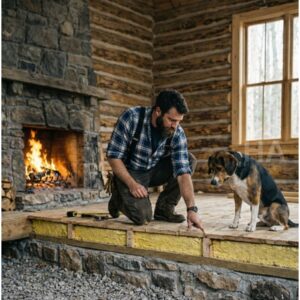
The furniture was old but solid, the kind his uncle had always preferred. On the mantle sat a photograph of his uncle in a Vietnam-era uniform, holding a rifle, eyes sharp and clear. Beneath it lay a note in shaky handwriting.
«Tommy, if you’re reading this, I’m gone. I know what happened to you. I know about Karen, about Emily, about the streets.»
The note continued. «I couldn’t find you to help, but I can help now. This place saved me after Vietnam. Maybe it can save you too. Don’t give up. You’re still a Marine. Semper Fi. Uncle Jack.»
Thomas sat on the floor and cried for the first time in four years. He spent the next four days cleaning, sweeping out years of dust, washing windows, and repairing the porch steps. Every movement felt strange: having space, having purpose, having walls.
On the fifth morning, he woke to voices outside. Thomas walked into the clearing three hundred meters from his cabin and found them. Eight men were unloading gear from three trucks: rifles, coolers, and camping equipment.
They moved with the casual confidence of people who’d been doing this for years. A man in his mid-forties, tall and broad-shouldered, noticed him first. His eyes narrowed instantly.
«Who the hell are you?»
Thomas’s voice was rough from disuse. «I own this property. This is my land.»
The man laughed. Actually laughed. «Your land? You’re joking, right?»
«I inherited the cabin. I have the deed.»
The man’s smile faded into something uglier. «You inherited it. A homeless guy inherited prime hunting property.» He turned to his group. «Guys, apparently we’ve been trespassing. The bum owns the place now.»
One of the younger men, maybe late twenties, smirked. «Seriously? This is the new owner? What did you do? Find the deed in a dumpster?»
Thomas reached into his jacket and pulled out the folded papers. His hands shook as he held them out. The tall man snatched them and glanced over the documents, his jaw tightening.
«Garrett Mitchell,» he said, not offering his hand. «Lieutenant Colonel, U.S. Army, retired. And you are?»
«Thomas Brennan.»
«Well, Thomas, here’s the situation. My group has been using this area for eight years, every November. It’s tradition. And now you’re telling me that’s over because some lawyer gave you a piece of paper?»
«It’s not just a piece of paper, it’s legal ownership.»
Garrett handed the deed back with two fingers, like it was contaminated. «You know what I see? I see a guy who couldn’t handle civilian life, a guy who gave up. And now you want to play property owner?»
He stepped closer. Thomas could smell expensive cologne mixed with gun oil. «Where did you serve?»
«Marine Corps.»
«Doing what? Supply? Admin?»
«Scout sniper. Instructor at Quantico.»
The words hung in the air. One of the older men in the group, with a weathered face and careful eyes, straightened slightly. «Quantico. What years?»
«2006 through 2013.»
The older man’s eyes widened. «What was your call sign?»
Thomas hesitated. He hadn’t said it out loud in six years. «Iceman.»
The older man, Davis, went pale. «Jesus Christ, Iceman Brennan. You’re Thomas Brennan?» He turned to Garrett. «Garrett, this man is a legend. He trained half the sniper instructors in the Corps. He has records that still stand.»
Garrett’s face darkened. His ego, already bruised, now took the hit fully. «Records? Really?» He looked Thomas up and down with exaggerated slowness.
«From a guy who’s been living in the gutter for how long? Six years?» He turned to his group, his voice rising. «You want me to respect a Marine who couldn’t even keep his life together? Look at him. He’s shaking. He probably hasn’t held a rifle since he fell apart.»
Something shifted in Thomas’s eyes. Not anger. Something colder. Garrett saw it and pressed harder.
«You know what, Iceman? Let’s make this interesting. A challenge. You and me. Eight hundred meters. Five shots each. Best grouping wins.»
He paused for effect. «You win, I pay you five thousand dollars and never step on your property again. I win, you sell me the cabin for ten grand and disappear.»
«I’m not interested in proving anything.»
«Of course you’re not.» Garrett’s smile was vicious. «Because you know you’ve lost it. Six years trembling on street corners, begging for change, drinking to forget on park benches. And now you want to stand here and pretend you’re still the great Iceman?»
He leaned in close. «Your time is over, old man. You’re a ghost. A joke. A cautionary tale about Marines who couldn’t adapt.»
The young man, Jake, spat near Thomas’s feet. «Take the money and run, bum. You don’t belong here.»
Davis stepped forward. «Garrett, stop. The man has legal ownership. Leave him alone.»
Garrett whirled on him. «You’re defending this failure? After everything we’ve talked about regarding discipline and honor? He’s proof that not every veteran deserves respect. Some of them just give up.»
Thomas stood very still. In his mind, a memory surfaced. Iraq, 2008. Sand and heat and the weight of a rifle. A voice on the radio.
«Iceman, we have twelve souls in that convoy. You’re the only one who can make this shot.»
The target had been 1,847 meters away. Wind howling. Dust storm approaching. He’d calculated everything in thirty seconds. Adjusted. Breathed. Fired.
Twelve people went home to their families that night. He looked at Garrett. When he spoke, his voice was quiet.
«If I accept your challenge, it’s not for money. If I win, you admit in front of everyone here that you’re wrong. You apologize. If you win, I leave and you never see me again.»
Garrett’s smile widened. «Deal. Let’s see what the legendary Iceman has left in the tank.» He turned to his group. «Set up the targets. Eight hundred meters. This should be entertaining.»
What Garrett didn’t know was that at that exact moment, 2,300 miles away in Virginia, a Marine gunnery sergeant was teaching a class of new sniper students. On the wall behind him hung a photograph of instructors past. Third from the left, eyes like winter ice, stood Thomas Brennan.
The gunnery sergeant was telling his students about a man who could calculate wind, humidity, and earth’s rotation in his head. A man whose hands never shook. Whose heartbeat never rose above fifty-two during a shot.
A man they called Iceman. And the only question that mattered now was whether six years of hell had erased what fifteen years of training had burned into his soul.
The targets went up across the valley. Five paper silhouettes mounted on wooden frames spread twenty meters apart laterally. Exactly eight hundred meters from the firing position.
The wind came from the northeast at roughly twenty kilometers per hour, gusting occasionally higher. Temperature eight degrees Celsius. Humidity sixty-three percent. Elevation difference between shooter and target: forty-two meters down.
Thomas calculated all of it automatically. He hadn’t thought in these terms in six years, but the moment he saw the targets, his mind shifted. It was like muscle memory in his brain.
Garrett set up two rifles side by side. Both Remington 700s chambered in .308 Winchester. Identical Leupold Mark IV scopes.
«Same equipment,» he announced. «Level playing field, no excuses.»
He positioned himself prone, the rifle snug against his shoulder. His movements were practiced, professional. He’d been shooting competitively for fifteen years. He was good.
He fired five shots in four minutes. Smooth, controlled, methodical. Ryan Cross, a sport shooter in the group, watched through high-powered binoculars.
«Four shots in the nine ring. One X ring. That’s a solid group, Garrett. Maybe six inches total spread.»
Garrett stood, brushing dirt from his jacket. He wasn’t smiling anymore, but there was satisfaction in his eyes. «Your turn, Iceman. Try not to embarrass yourself.»
Thomas walked to the firing line. The rifle felt foreign and familiar at the same time. He picked it up, and immediately his hands began to tremble.
Not a little. Visibly.
Jake laughed. «Oh, man. Look at him. He can’t even hold it steady.»
Thomas closed his eyes. In his mind, he was twenty-eight years old, lying in the dust of Alhambra province, watching a high-value target through a scope. His spotter, Corporal Ramirez, was next to him.
«Iceman, you good?»
Thomas had nodded. His hands were rock steady. His breathing was controlled. He was a machine.
But that was before Karen died. Before he watched her waste away for two years, unable to stop it, unable to save her. Before he’d grabbed his own daughter during a PTSD flashback and seen terror in her eyes.
Before six years of concrete and cold and shame.
He opened his eyes. His hands still shook. He reached into his jacket and pulled out a worn leather journal. The diary he’d kept since 2006.
Every shot. Every variable. Every mission. He opened it to a random page.
«December 2009, Afghanistan. Wind fifteen knots. Target one thousand two hundred meters. Temperature minus twelve Celsius. Success.»
He turned to another page. «March 2011. Wind twenty-two knots. Target nine hundred eighty meters. Success.»
He closed the diary and placed it carefully beside him. Then he lay down in the prone position. The moment his cheek touched the rifle stock, something happened.
His hands stopped shaking. Completely. Davis saw it. His breath caught. «My God,» he whispered.
Thomas didn’t hear him. He was calculating. Wind speed at ground level versus wind at the bullet’s apex. Temperature effect on powder burn.
Humidity’s impact on air density. The Coriolis effect at this latitude. His mind moved through the mathematics like water flowing downhill.
Twelve seconds. All variables accounted for. He adjusted the scope. Three clicks right. One click up.
His breathing slowed. In through the nose for four seconds. Hold for two. Out through the mouth for six.
His heart rate dropped. Fifty-eight beats per minute. Fifty-four. Fifty-two.
He squeezed the trigger. The rifle bucked, and the sound echoed across the valley. Two seconds of flight time.
Then, a distant metallic ding from the steel backing behind the paper target. Ryan, watching through the binoculars, froze. «X-ring. Dead center.»
Garrett frowned. «Beginner’s luck. Let’s see him do it again.»
Thomas didn’t move except to work the bolt. He ejected the spent casing and chambered a new round. Same breathing pattern. Same heart rate.
The world narrowed to the reticle and the target. Second shot. Ding.
Ryan’s voice was quieter. «X-ring. Same hole.»
The group went silent. Jake’s smirk faded. Thomas cycled the bolt again. In his mind, a flash of memory: Iraq, 2008.
The convoy under fire. His spotter’s voice. Iceman. Target is 1,147 meters. Wind is 32 kilometers per hour. Variable. You have one shot.
Thomas had calculated everything. Adjusted. And fired. The enemy sniper had dropped. The convoy moved. Twelve souls saved.
Third shot. Ding.
Ryan’s hand shook as he held the binoculars. «He’s stacking them. All three shots in the same hole. That’s impossible at 800 meters in this wind.»
Ashley Brennan, the sixty-year-old woman from the neighboring property, had walked up during the challenge. She’d known Thomas’s uncle. Now she stood twenty feet behind the group, hand over her mouth.
Her brother had been a sniper in Vietnam. She knew what she was seeing. Tears began to roll down her weathered cheeks.
Thomas breathed. His mind was clear now. Clearer than it had been in six years. He wasn’t on a mountain in North Carolina.
He was everywhere he’d ever been. Every rooftop in Fallujah. Every ridge in Helmand Province. Every training range at Quantico where he’d taught young Marines that precision was compassion.
That one perfect shot could save a dozen lives. Fourth shot. Ding.
Ryan lowered the binoculars. His face was white. «Four rounds. One hole. I’ve never seen anything like this. Not in competition. Not anywhere.»
Michael Santos, the Navy veteran in the group, stood at attention without realizing it. He recognized excellence when he saw it. Thomas prepared for the fifth shot.
This one was different. Before he fired, he closed his eyes for three seconds. His lips moved silently. He was saying a name.
Karen.
He opened his eyes. Settled. Breathed. Fifth shot. Ding.
Ryan’s voice broke. «Five rounds. One hole. The group is less than one inch at eight hundred meters, with wind, with a rifle he’s never fired before.»
He turned to Garrett, who stood frozen. «That’s not human. That’s not possible. But he just did it.»
Thomas stood. He worked the action, cleared the chamber, and engaged the safety. He handed the rifle back to Garrett without looking at him.
Then he started walking toward the cabin. Garrett’s face was red, then white, then red again. His mouth opened and closed.
Finally, words came out, desperate and hollow. «It was luck. It had to be luck.»
Thomas stopped. He didn’t turn around. His voice carried across the clearing, quiet but absolute.
«It wasn’t luck. It was 4,387 hours of training, 892 missions, 14 years of muscle memory that no amount of cold, hunger, or pain could erase, and six years of wondering if I’d lost it all.»
He paused. «Thank you for answering that question.»
He continued walking. Behind him, Davis Coleman came to attention and saluted. Michael Santos did the same.
Ryan Cross just stood there, the binoculars hanging from his neck, shaking his head in disbelief. Craig Whitmore, the wildlife photographer who’d been in the area by chance, had filmed the entire exchange. His hands trembled as he lowered the camera.
He’d just captured something he couldn’t fully understand, but knew was extraordinary. Jake Thornton, the young man who’d mocked Thomas, turned away and retched behind a tree—not from sickness, but from shame. He’d just ridiculed a man who possessed a level of skill Jake couldn’t comprehend if he’d trained for ten lifetimes.
Garrett Mitchell stood alone in the clearing. His group had gone quiet. His authority, built on ego and bluster, had evaporated.
He’d challenged a legend and been crushed. Not by arrogance, but by precision. By excellence so pure it was untouchable. He fell to his knees, not in respect, but in the devastating realization that he’d humiliated himself in front of everyone who mattered to him.
Someone, somewhere, had made a decision that would collide with Thomas’s forgotten past. Craig’s decision to post that video online. When he did, nothing about Thomas’s life would ever be the same again.
That night, Thomas sat on the cabin’s porch. The sun set over the valley, painting the sky in shades of orange and purple. He held a cup of coffee—real coffee, not the dregs he’d found in gas-station trash cans for six years.
His hands were steady. The leather diary sat on the railing beside him. He opened it to the last entry. August 17, 2013. The day before Karen died.
He’d written: Training Exercise. Recruits struggling with wind calculation. Reminded them that patience and precision save lives. Heading home tonight. Karen’s last chemo tomorrow. Praying for a miracle.
There had been no miracle. She’d died three days later, and Thomas had shattered like glass. He turned the page. It had been blank for six years.
Now he picked up a pen he’d found in the cabin. His hand hovered over the paper. Then he wrote: November 9, 2019. 800 meters. Five rounds. Proved to myself I’m still here, still capable, still Iceman. Not sure what that means yet, but it’s a start.
He closed the diary and sipped the coffee. The night air was cold but not unbearable, not like the bridge in Greenville where he’d slept for seventy-three months. Inside the cabin, he’d found his uncle’s old radio.
It worked. He’d tuned it to a classical station. Beethoven drifted through the open window. Karen had loved Beethoven.