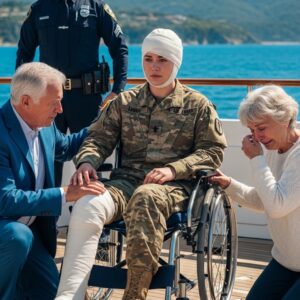
The concrete hit my palms first, gritty and unforgiving, followed instantly by the jarring slam of my shoulder, then the dull thud of my head. It wasn’t hard enough to black out—unfortunately—but it was hard enough that the world tilted sideways and stayed there, the cloudless July sky spinning like a warped record.
I lay there, the taste of copper flooding my mouth where I’d bitten my tongue. The backyard of my Aunt Linda’s house in Northbrook was spinning, though I hadn’t touched a drop of the beer chilling in the orange cooler nearby. Fifty people—my blood relatives, my childhood friends, my neighbors—were staring down at me. Some were laughing, a nervous, twittering sound. A few had their phones out, the black lenses like unblinking eyes recording my humiliation.
Towering over me was my brother, Tyler. His chest was heaving, his face flushed a mottled red that spoke of righteous indignation and three Bud Lights.
Stop faking for attention,” he spat, his voice booming across the patio. It was loud enough for the neighbors three houses down to hear. Loud enough to stop the axe-throwing game in the corner of the yard. “It’s getting old, Marcus.”
My wheelchair lay tipped on its side two feet away, one wheel still spinning lazily in the oppressive heat. My right leg was twisted at an unnatural angle, sending lightning bolts of white-hot agony shooting up my spine—the kind of pain I had learned to breathe through over the last 26 months, but which never truly got easier to bear.
The family reunion continued around me as if I were nothing more than a piece of lawn furniture that had toppled over in the wind. Someone turned up the country music. A kid ran past chasing a whiffle ball, indifferent to the body on the ground. The smell of burgers charring on the grill mixed with the scent of cut grass and the metallic tang of my own blood.
Get up, Marcus,” Tyler sneered. I could hear the thick satisfaction in his voice, the vindication he’d been craving for two years. “Everyone’s watching. Time to drop the charade.”
I tried to push myself up. My arms shook violently. The concrete had scraped my palms raw, and I could see tiny shards of gravel embedded in the meat of my left hand, blood welling up around them like dark garnets.
Look at him!” Tyler announced, turning to address our assembled relatives like a prosecutor delivering a closing argument. “He’s been milking this wheelchair thing for two years, ever since the accident that nobody actually saw.”
I was there,” my mom said from somewhere in the crowd. Her voice was thin, reedy, the voice of a woman beaten down by years of mediating conflicts she didn’t understand.
You found him at the bottom of the stairs,” Tyler corrected, pointing a finger at her. “That’s not the same thing as witnessing it. For all we know, he threw himself down on purpose to get out of deploying.”
The crowd murmured. “Agreement?” “Consideration?” It rippled through them.
My cousin Jake, a twenty-three-year-old who still lived in his parents’ basement, stepped forward from the circle. “Dude, I swear I saw him walk at the Jewel-Osco on Roosevelt Road last month. He was in the cereal aisle. Standing.”
The murmuring grew louder. Heads nodded. “Of course,” my Aunt Linda whispered loudly. “I always suspected.”
That was physical therapy,” I managed to choke out from the ground, my voice smaller and weaker than I wanted it to be. “I told everyone about the outpatient program at Rush…”
Sure it was,” Tyler interrupted, kicking the frame of my wheelchair. The aluminum rang out like a harsh bell. “Meanwhile, you’ve been collecting disability checks and living in Mom’s basement rent-free for two years. Playing video games, ordering DoorDash on her credit card, living the dream while the rest of us work for a living.”
Because I can’t work,” I gritted out.
Because you won’t work,” Tyler countered, crouching down until his face was inches from mine. I could smell the stale beer and barbecue sauce on his breath. “There’s a difference, little brother.”
My Uncle Richard—my dad’s younger brother, the insurance salesman who drove a leased Lexus and preached personal responsibility at every holiday—pulled out his Samsung Galaxy. He held it up horizontally, documenting the scene.
I’m recording this,” Richard announced solemnly. “For evidence. We’ve all been enabling this behavior for too long. It’s time someone stood up for the truth.”
I looked around for support. For anyone. My mom stood near the picnic table, wringing her hands, looking at the ground. My Aunt Linda, the organizer, stood with her arms crossed, lips pursed in judgment. My grandmother sat in her lawn chair under the oak tree, fanning herself with a paper plate, watching me like I was a disappointing episode of a soap opera.
Nobody moved to help.
The doctors said…” I started, desperate.
Maybe,” Tyler interrupted, cutting me off. He was on a roll now, feeding off the crowd’s energy. “Maybe you’ll walk again. Maybe it’s permanent. Maybe, maybe, maybe. You’ve been dining out on ‘Maybe’ for twenty-four months while Mom bankrupts herself trying to fix you.”
He does look awfully comfortable in that chair,” my grandmother said, loud enough for the silence to catch it. “Like he’s been practicing.”
Tyler reached down and snatched my wallet from my jacket pocket where it had spilled out. He held it up like a trophy. He flipped it open.
See this? Disability card. Eight hundred and thirty-seven dollars a month. Plus, Mom pays for everything else. Rent, food, medical supplies, special equipment.”
I have medical bills,” I whispered. My throat was closing up. My hands were shaking, and it wasn’t just from the fall. It was the shame. The absolute, crushing weight of their judgment.
You have excuses.” Tyler threw the wallet at me. It hit my chest and fell open, my driver’s license staring up at me—the photo taken before the accident, when I could stand for the DMV camera without support. “The gravy train ends today, Marcus. Right here, right now.”
The crowd started clapping. Actually clapping. As if Tyler had just delivered an inspirational speech about overcoming adversity, rather than kicking his crippled brother while he was down.
Tyler, that’s enough.” Mom finally stepped forward, but her voice had no force behind it. She sounded like she was asking permission.
No, Mom. He’s bleeding you dry.” Tyler’s voice softened when he looked at her, becoming gentle, concerned. “Physical therapy three times a week. Special equipment. That modified Honda Odyssey you bought. You took out a second mortgage for him on a house you’ve lived in for thirty years. You’re sixty-two years old, and you’ll be paying that off until you’re eighty.”
Mom’s face went crimson. She didn’t deny it. I felt a cold knot form in my stomach; I hadn’t known about the second mortgage.
I didn’t ask her to do that,” I said.
You didn’t stop her either!” Tyler pointed at me, his finger like a weapon. “You just kept taking. Kept bleeding her dry. Kept playing the victim while everyone else sacrificed for you.”
He crouched down again, his eyes hard and glassy. “Stand up right now,” he said quietly. “Or I’m calling the police for disability fraud. Insurance fraud. Whatever fraud applies. You’ll go to jail, Marcus. And honestly? That might be better for everyone.”
I can’t.” The pain in my leg was screaming now, a distinct, tearing sensation near the knee.
Stand up!” Tyler yelled.
And then, the family started chanting.
Stand up. Stand up. Stand up.”
Fifty voices. Maybe more. The neighbors had come to the fence to watch. Kids were recording on their phones. Aunt Linda was clapping in rhythm, leading the chant like a cheerleader at a pep rally.
I stayed on the ground because I couldn’t do anything else. Because my right leg hadn’t had full sensation in twenty-six months. Because the titanium rods in my spine made certain movements impossible. Because everything Tyler was saying—all the cruelty, all the accusations—came from a place of willful ignorance.
Tyler grabbed my shirt collar and hauled me halfway up. “I’m done watching you manipulate everyone! You’re a liar, a con artist, and a—”
THAT IS MY PATIENT! YOU ARE ASSAULTING HIM!“
The voice didn’t shout, but it cut through the chanting like a razor blade. It was authoritative, precise, and terrifyingly calm.
Everything stopped. Tyler’s grip on my shirt loosened, but he didn’t let go.
Tyler dropped me. I hit the concrete again, a fresh wave of nausea rolling over me.
Cliffhanger:
I looked up through the haze of pain to see a figure stepping out of the shadows of the patio umbrella. He held a can of Diet Coke in one hand and a phone in the other. He looked like he had been enjoying the show, but his eyes… his eyes were cold enough to freeze the humid July air. And he was walking straight toward Tyler.
Who the hell are you?” Tyler demanded, stepping back, his chest still heaving.
The man was in his mid-fifties, Asian, wearing crisp khakis and a navy polo shirt. He adjusted his wire-rimmed glasses and took a casual sip of his soda.
Dr. James Chen,” he said. “Marcus’s orthopedic surgeon. Among other things.”
The crowd went completely silent. You could hear the burgers sizzling on the grill, a dog barking three yards over, and the country music still playing tinny and small from a Bluetooth speaker.
I am also his physical therapist, his pain management specialist, and I consult with his neurologist, Dr. Sarah Patel, at Northwestern Memorial,” Dr. Chen continued, his voice smooth and level. “I have been treating Marcus since approximately forty-seven hours after his accident, twenty-six months ago.”
My Aunt Linda laughed. It came out nervous, shrill. “Well, Doctor, you must be very proud. Your patient can apparently walk just fine when nobody’s looking.”
Dr. Chen smiled. It didn’t reach his eyes. It was a terrifying, shark-like smile.
Actually,” he said, pulling out his iPhone. “I have something everyone should see.”
He held it up. The screen was bright, cutting through the afternoon glare. An X-ray filled the display.
This is Marcus’s lumbar spine. Specifically, his L4 and L5 vertebrae.” He zoomed in with two fingers, the movement practiced and clinical. “See these metal rods? Four of them. And these screws? Fourteen total. That is from his spinal fusion surgery, performed by me, fourteen months ago at Rush University Medical Center. The surgery took seven hours. The recovery took six months.”
Nobody spoke. Tyler had gone very still.
The reason Marcus can stand during physical therapy sessions,” Dr. Chen continued, addressing the crowd like a lecture hall, “is because we are systematically training his body to handle short distances with a walker. Currently, he can manage approximately forty-seven meters before the nerve damage causes pain severe enough to require immediate rest. That is about five minutes of mobility.”
He stepped closer to Uncle Richard, who was still holding his phone up.
After that five minutes,” Dr. Chen said, staring into Richard’s camera lens, “the damaged nerves begin firing incorrectly. He experiences what we call neuropathic pain. Imagine someone driving rusty nails into your leg while simultaneously shocking you with a cattle prod.”
He swiped to another image. “Here is his sciatic nerve, right side. See this dark area? Permanent nerve damage from the fall. It is why his right leg has limited proprioception—the ability to sense where your body is in space. It is why he cannot bear significant weight for extended periods. The nerve misfires. Sometimes the leg just gives out. No warning.”
My cousin Jake had backed away from the circle, disappearing toward the house.
The orthotic brace he wears—the one that costs four thousand dollars and isn’t fully covered by insurance—provides stability, but it is not a cure. There is no cure.” Dr. Chen’s voice remained perfectly level, clinical, devastating. “This is his life now. Every day is painful. Every step is uncertain. Every moment in that wheelchair is a reminder of what he has lost.”
He looked directly at Tyler. “But sure. He’s faking.”
Dr. Chen held his phone higher so everyone could see. Then he swiped again.
This is a video I recorded approximately seven minutes ago, starting from the moment I arrived at this lovely family gathering.”
He pressed play.
Tyler’s voice came through the tiny speaker, tinny but unmistakable. “Stop faking for attention.” The sound of me hitting the concrete. The laughter. The chanting.
Dr. Chen let it play for thirty seconds, then stopped it.
I recorded everything,” he said calmly. “The assault. The verbal abuse. The crowd participation. The public humiliation of a disabled man by his own family.” He looked at Uncle Richard. “You are not the only one gathering evidence today. Thank you for your recording, by the way. It documents conspiracy to intimidate a disabled person.”
Uncle Richard’s hand was shaking now. He lowered his phone slowly.
Tyler stumbled backward, his hip hitting the picnic table. “I was just… we all thought… the evidence seemed…”
You thought wrong,” Dr. Chen’s voice went cold as ice. “You didn’t think at all. You didn’t ask questions. You didn’t request medical records. You didn’t consult with his doctors. You just assumed he was lying because it was easier than accepting that sometimes terrible things happen to good people and there is no one to blame.”
He knelt beside me with a practiced ease that came from years of treating patients. “Can you move, Marcus?”
I nodded. Barely.
Rate your pain. One to ten.”
Eight,” I whispered. “Maybe nine.”
He examined my leg with gentle, professional hands, feeling along the knee, the ankle. His expression darkened. “Possible ligament damage. We will need imaging.”
He looked up at the crowd. “Someone get his wheelchair. Now.”
My mom moved first. She righted the chair, wheeled it over. She was crying silently, tears streaming down her face, but making no sound. Dr. Chen helped me back into the chair with the kind of careful precision that comes from doing this a thousand times.
Dr. Chen straightened up and addressed the entire gathering.
I came here today because Marcus asked me to.” His voice carried across the yard. “He knew this confrontation was coming. He has heard the whispers. He has seen the Facebook posts. So he asked me—his doctor, his surgeon, the man who cut open his back and installed metal in his spine—to attend this reunion. To watch. To document.”
He pulled a business card from his wallet and handed it to Tyler.
That is my lawyer’s contact information. Her name is Jennifer Wu. She is a partner at Kirkland & Ellis, specializing in disability rights litigation. I will be filing a police report tomorrow for assault of a disabled person, along with a civil lawsuit for battery, assault, and intentional infliction of emotional distress.”
Tyler stared at the card like it might bite him.