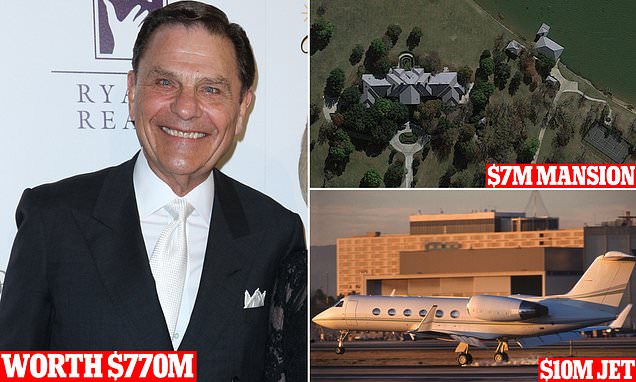
Televangelist Kenneth Copeland, often recognized as the wealthiest pastor in America, reportedly has a net worth of $760 million. His lavish lifestyle has sparked controversy, especially his alleged tax-free living in a $7 million mega-mansion. Located in an exclusive lakefront community near Fort Worth, Texas, this 18,000-square-foot estate features six bedrooms, six bathrooms, a tennis court, two garages, and a covered boat dock.
A Mansion With Minimal Taxes
Built on an acre of land and surrounded by 24 acres of lakefront property, Copeland’s estate is officially owned by his Eagle Mountain International Church. While the property’s market value is estimated to be in the millions, it has been appraised at an “extraordinarily low” $1,250,000. This valuation results in annual property taxes of less than $3,000, a fraction of the estimated $150,000 in taxes if the property were appraised at its true value.
The discounted valuation was part of a dispute resolution agreement with the Tarrant Appraisal District, though real estate experts assert the waterfront property would fetch significantly more in an open market. Copeland has declared the estate a “clergy residence,” allowing it to qualify for a 100% tax exemption.
Copeland’s Justification
Copeland has publicly defended his mansion and lifestyle. During a 2015 speech at the Southwest Believers’ Convention in Fort Worth, he stated that building the estate was a directive from God, calling it part of his prosperity and a gift for his wife, Gloria. The property, completed in 1999, includes a sweeping spiral staircase, a living room-spanning bridge, crystal chandeliers, castle-sourced doors, and even a ceiling projector in the bedroom.
“You may think that house is too big. You may think it’s too grand. I don’t care what you think. I heard from heaven. Glory to God, hallelujah!” Copeland declared at the convention.
A History of Controversy
Copeland’s prosperity gospel teachings, which assert that God wants believers to achieve financial success, have long been a subject of debate. His refusal to fly commercially, citing the need for private jets to “do God’s work,” has also drawn criticism. In a 2019 interview, Copeland stated, “It takes a lot of money to do what we do. We have brought over 122 million people to the Lord Jesus Christ.”
Critics argue his tax exemption undermines the purpose of the law. Pete Evans, president of the Trinity Foundation, remarked, “The law was never intended to give breaks to millionaires and multimillionaires. You make a mockery of the law itself.”
The Bigger Picture
Kenneth Copeland’s lifestyle highlights a contentious intersection between faith, wealth, and tax exemptions granted to religious organizations. As America’s wealthiest pastor, Copeland reportedly benefits from significant financial advantages, including living in a $7 million mansion tax-free. His estate, declared a “clergy residence,” allows for a complete tax exemption, despite its market value being estimated in the millions. This arrangement, enabled by a discounted appraisal, reduces his annual property taxes to less than $3,000—far below the $150,000 typically owed for such a property.
While Copeland defends his lavish lifestyle as divinely ordained and integral to his ministry, critics argue that such privileges undermine the spirit of tax laws intended to support modest clergy housing, not extravagant estates. His teachings, rooted in the “prosperity gospel,” further fuel debate by promoting the belief that financial success aligns with God’s will.
This case raises broader questions about the use of tax exemptions by religious organizations and whether they should apply to multimillionaire pastors. Critics, including watchdog organizations, contend that such benefits make a mockery of the law, allowing personal wealth accumulation at the expense of public revenue. Copeland’s story invites reflection on balancing religious freedoms with financial accountability in the modern era.